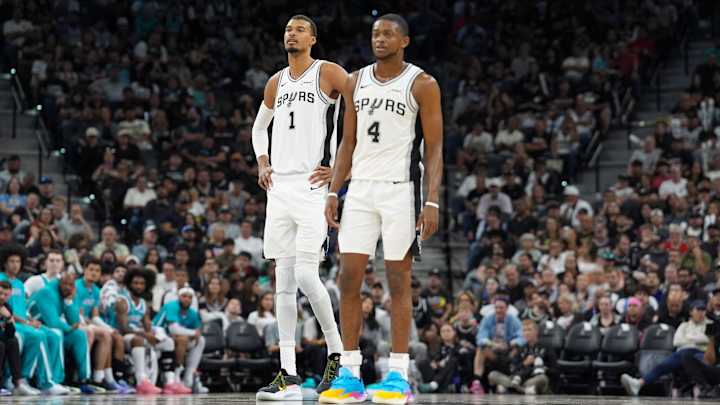
The San Antonio Spurs’ magical, ahead-of-schedule run to the 2026 NBA Finals ended in agonizing heartbreak. In just five games, the New York Knicks captured their first championship in over half a century, leaving a visibly devastated Victor Wembanyama to face a long, agonizing summer of “what-ifs.”
The 22-year-old French phenom didn’t hide his pain, bypassing the traditional post-series handshakes and delivering a raw, emotional press conference.
”This is the biggest lesson of my life, the biggest learning moment,” Wembanyama admitted. “I can’t tell exactly what the lesson is, but we’re learning from that, for sure.”
While the generational superstar processes the disappointment, the blueprint for his evolution is already clear. If Wembanyama wants to transform this agonizing defeat into a future dynasty, he must master these five critical lessons from the 2026 NBA Finals.
1. Respect the Process of Winning It All
It is easy to forget just how historic the Spurs’ season actually was. The last time a team this young and inexperienced went from lottery status straight to the NBA Finals was Bill Walton’s 1977 Portland Trail Blazers.
The modern postseason is an entirely different beast, and history shows that even the greatest icons must get their teeth kicked in before lifting the Larry O’Brien Trophy:
- The Knicks were bounced in the second round twice and lost in the ECF last year before finally breaking through.
- The Celtics endured nine consecutive years of playoff heartbreak—including four Conference Finals exits and a Finals loss—before capturing their 18th title in 2024.
The Spurs showed elite resilience by navigating a brutal Western Conference and dethroning the Oklahoma City Thunder on their own floor. They now possess the ultimate roadmap. The pain of watching another team celebrate on your floor is a mandatory rite of passage for NBA royalty.
”What I’m pissed about,” Wembanyama candidly noted, “is there’s probably 100 games before we can be back in the Finals… I’m going to have to hold that inside of me and execute for 100 games.”
2. The Fourth Quarter is a Different Sport
If this series taught San Antonio anything, it’s that building a lead means absolutely nothing if you cannot close. The Spurs’ inability to execute under pressure was catastrophic:
- Game 1: Blw a 14-point lead; lost by 10.
- Game 2: Blew a 12-point lead; lost by one.
- Game 4: Blew a 29-point lead in the largest historical collapse in NBA Finals history, capped off by an OG Anunoby putback.
- Game 5: Blew a 16-point lead; lost by four.
When the pressure mounted, Wembanyama buckled. In the fourth quarters of the Finals, he averaged just 7.8 points on a dismal 34.3% shooting from the floor, 25% from deep, and missed five crucial free throws—including two late-game misses that doomed them in Game 4.
Compare that to Finals MVP Jalen Brunson, who demanded the ball and torched the Spurs in final frames, averaging 11.2 points on 51.4% shooting (42.9% 3PT). To become the undisputed face of the league, Wembanyama must learn to embrace the clutch rather than shrink from it.
3. Stop Settling and Dominate the Paint
During the 2026 playoffs, Wembanyama was an absolute cheat code around the rim, converting a staggering 68.7% of his shots in the restricted area on 150 attempts. When he gets to the block, he is fundamentally unstoppable.
The problem? The further he moves from the basket, the more opposing defenses celebrate.
📊 Victor Wembanyama’s Postseason Shooting Efficiency:
- Restricted Area: 68.7%
- 3-Point Range (vs. Knicks): 27.3% (9-of-33)
- Mid-Range (vs. Knicks): 30.8%
- 10-19 Feet: 33.3%
The Knicks’ defensive committee of Karl-Anthony Towns, Mitchell Robinson, and OG Anunoby focused entirely on pushing Wembanyama out to the perimeter. Instead of fighting for deep post position, Wemby settled for low-efficiency perimeter looks—most notably a contested mid-range jumper that rimmed out at the buzzer in Game 2.
An unguardable 7-foot-4 alien shouldn’t bail out the defense by settling for jumpers when the season is on the line.
4. Hand the Keys to Castle and Harper (Even if it Means Trading Fox)
If there is a massive silver lining for San Antonio, it is the revelation of their terrifying young three-man core. While veteran point guard De’Aaron Fox suffered a brutal postseason slump filled with critical late-game blunders, the Spurs’ rookies proved they belong on the big stage.
- Stephon Castle: Emerged as an elite, All-Defense caliber weapon, averaging 18.2 points, 5.0 rebounds, and 6.1 assists while seeing his perimeter shooting spikes when it mattered most.
- Dylan Harper: At just 20 years old, Harper was arguably San Antonio’s most consistent offensive engine in the Finals, shooting a hyper-efficient 51.5% from the floor throughout the playoffs.
The future of the Spurs relies on empowering Castle and Harper. However, managing this creates a massive luxury-tax headache, with De’Aaron Fox owed $221 million over the next four years. Whether the organization attempts a risky three-guard lineup or aggressively shops Fox this summer, Wembanyama’s ultimate allies have already arrived.
5. Embrace the Villain Persona
Wembanyama’s refusal to shake hands after Game 5, combined with an uncalled forearm to Jalen Brunson’s head in Game 3, has officially turned him into New York City’s Public Enemy No. 1. Knicks fans have flooded social media labeling the young star as “dirty” and “sore.”
When asked about the hostile New York crowd, Wembanyama shrugged it off, joking that at least he hadn’t reached Trae Young levels of villainy yet.
But leaning into the hate might be his best move. Every all-time great needs an edge. If opposing fanbases want to vilify him for hating to lose, Wemby should weaponize that animosity. Besides, becoming the primary villain to Knicks fans instantly makes him a beloved cult hero to fanbases in Boston, Philadelphia, Miami, and beyond.