The New York Knicks are officially riding an unbelievable high. By capturing the 2026 NBA Championship, they finally ended a painful 53-year title drought, cementing their place at the top of the basketball world.
Their historic triumph marks the eighth consecutive year where a different franchise has raised the Larry O’Brien trophy.
While Finals MVP Jalen Brunson deservingly commands the headlines, New York’s true secret weapon shares a common thread with recent champions: limitless, elite roster depth. Beyond their star-studded starting lineup of Brunson, Karl-Anthony Towns, OG Anunoby, Mikal Bridges, and Josh Hart, the Knicks boast a relentless bench. Players like Mitchell Robinson, Deuce McBride, Landry Shamet, Jose Alvarado, and Jordan Clarkson can step into a high-stakes playoff game at any moment and deliver winning minutes.
On a recent episode of the ALL NBA Podcast, league insider Marc Stein highlighted how the rest of the NBA is viewing the Knicks’ masterclass as the definitive modern blueprint:
”[…] I think teams around the league are looking at the Knicks to see what they can glean for themselves, to see what they can use as a blueprint. […] In today’s NBA, because of the pace of play, because of the toll that injuries take and that everybody seems to deal with injuries, you need the deepest possible team. I mean, we’re seeing that and I think that’s something that teams will want to try to emulate.”
For the Toronto Raptors, this is the exact wake-up call Masai Ujiri and the front office need to heed as they look to take the next major leap in their evolution.
The Raptors’ Depth Problem: Shifting from Retooling to Contending
Toronto fans know exactly what a championship blueprint looks like. The legendary 2019 title run was built on the back of an elite superstar surrounded by an endless wave of high-IQ, plug-and-play depth. But looking at where the franchise stands seven years later, the roster is still a few steps away from being that well-oiled machine.
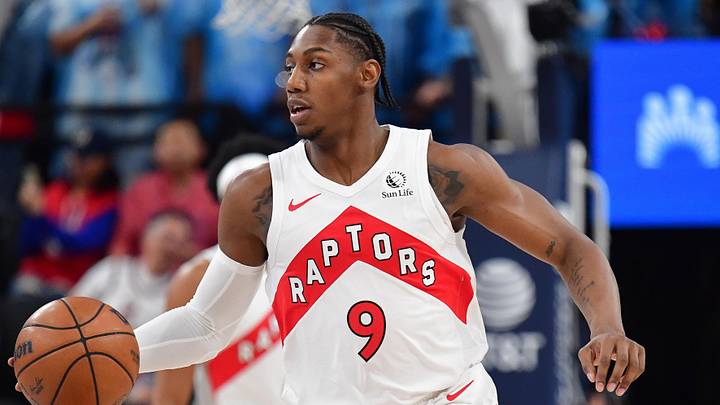
The Raptors have an incredibly exciting, talented core featuring Scottie Barnes, RJ Barrett, Immanuel Quickley, and Brandon Ingram. However, structural depth has held this team back for years.
While an 82-game season is an absolute war of attrition, Toronto’s lack of safety valves was brutally exposed last year. The team routinely struggled to stay afloat when injuries struck RJ Barrett and Jakob Poeltl, and those issues magnified in the postseason when Immanuel Quickley and Brandon Ingram were sidelined.
Roster Breakdown: The Playable Rotation Gap
While unexpected regular-season cameos from Jamison Battle, AJ Lawson, or Alijah Martin provide great feel-good stories, they highlight a harsh reality: Head coach Darko Rajakovic does not have 11 playoff-ready weapons at his disposal.
| Roster Status | Toronto Raptors (Current Roster Depth) | New York Knicks (Championship Standard) |
|---|---|---|
| Star Power / Core | Scottie Barnes, Brandon Ingram, RJ Barrett, Immanuel Quickley | Jalen Brunson, Karl-Anthony Towns, OG Anunoby, Mikal Bridges |
| Reliable Rotation Pieces | Jakob Poeltl, Collin Murray-Boyles, Gradey Dick | Josh Hart, Mitchell Robinson, Deuce McBride, Jose Alvarado, Jordan Clarkson |
| Current Rotation Size | 8 to 9 truly playable options (with Sandro Mamukelashvili hitting free agency) | 11 to 12 trusted, plug-and-play assets |
| Developmental / End of Bench | Jonathan Mogbo, Jamison Battle, AJ Lawson | Jeremy Sochan, Ariel Hukporti, Tyler Kolek |
The Next Step: Cutting Roster Waste and Adding Crucial Vets
If the Raptors want to replicate the Knicks’ success, the front office must stop burning roster spots on projects that Rajakovic isn’t fully confident throwing into the fire. The uneven development and experimental minutes given to younger prospects like Jonathan Mogbo and Gradey Dick prove that talent alone isn’t enough when the blows keep coming.
To survive the modern NBA’s breakneck pace and inevitable injury bugs, Toronto needs a roster where practically every single player can slot in at any given point and make an impact.
This summer, the front office must aggressively target elite, battle-tested veterans—the exact type of high-character role players the Knicks used to insulate their stars. By clearing out the dead weight on the bench and prioritizing proven, multi-positional depth, Toronto can finally transform from a plucky playoff team into a legitimate Eastern Conference powerhouse.