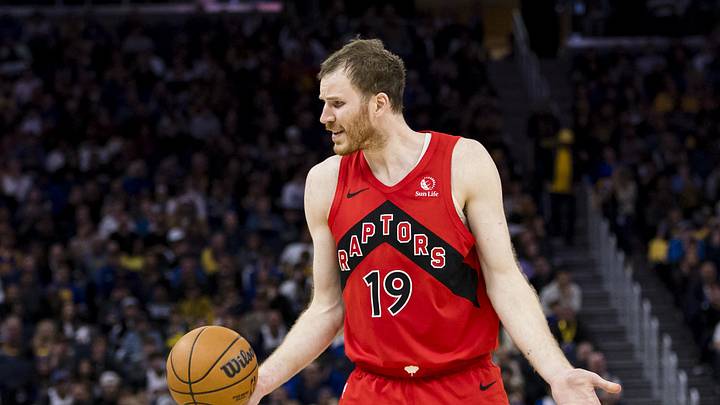
An absolute administrative and financial earthquake is brewing between Toronto and San Antonio. Following the Spurs’ devastating five-game collapse against the New York Knicks in the 2026 NBA Finals, a historic window of opportunity has opened for Toronto Raptors general manager Bobby Webster to pull off the ultimate financial exorcism.
According to a blockbuster structural blueprint originally outlined by Air Alamo, the Raptors are aggressively exploring an ambitious multi-player mega-deal. The proposal would successfully dump Jakob Poeltl’s widely panned, toxic long-term contract back onto his former franchise, simultaneously landing All-Star point guard De’Aaron Fox to ignite a new era alongside Scottie Barnes.
The San Antonio Meltdown: Why De’Aaron Fox is Available
The only reason a player of Fox’s elite caliber is being actively discussed on the trade market is due to deep structural discontent in Texas. Fox endured a catastrophic individual performance during the NBA Finals, completely choking under the bright lights against New York.
Compounding the problem is the immediate ascension of rookie sensation Dylan Harper, who flashed generational dominance off the bench and appeared completely ready to assume primary backcourt duties. With Fox about to step into a massive, highly lucrative contract extension that limits San Antonio’s financial flexibility, the Spurs are highly motivated to find a win-now package that clears the runway for the Harper era.
The Blockbuster Proposal Blueprint
To successfully match the incoming salary of Fox’s mega-extension—and to adequately compensate the Spurs for absorbing Poeltl’s negative asset value—the Raptors are prepared to sacrifice elite wing scoring and significant draft capital.
The Proposed Trade Framework:
The Tactical Domino Effect: Eliminating the One-Trick Pony
Beyond shedding Poeltl’s slow-footed interior presence, the trade allows Toronto to ruthlessly pivot away from Brandon Ingram. Despite securing a late All-Star nod this season, internal analytics view Ingram as a highly inefficient, one-trick isolation scorer who brings poor defensive awareness and disastrous off-ball spacing to the floor. Shifting his remaining $80 million obligation clears immense long-term breathing room.
| Target Player Asset | Current Roster Dilemma | New Tactical Realization |
|---|---|---|
| Jakob Poeltl | Negative Value / Untradeable Contract | Replaced by Collin Murray-Boyles at Center |
| Brandon Ingram | Poor Defense / Disastrous Off-Ball Spacing | Opens Wing Minutes for Ja’Kobe Walter |
| De’Aaron Fox | Post-Finals Scapegoat in San Antonio | Dynamic Second Creator Beside Scottie Barnes |
For Toronto, the on-court fit of De’Aaron Fox is a seamless basketball calculation. His elite downhill penetration provides the dynamic second creator the franchise has lacked since the postseason exit.
Defensively, the length of Scottie Barnes and the interior presence of incoming big man Collin Murray-Boyles—who would instantly inherit the starting center role—will perfectly insulate Fox’s perimeter defensive liabilities. To maintain structural balance, head coach Darko Rajaković could transition Canadian star RJ Barrett into an elite, high-volume Sixth Man role, inserting young sharpshooter Ja’Kobe Walter into the starting unit to optimize floor spacing.
While the draft capital requirements remain a major negotiation hurdle, executing this swap instantly repairs Toronto’s cap health while cementing a legitimate Eastern Conference powerhouse.
Should the Toronto Raptors mortgage their future draft capital to land De’Aaron Fox and erase Jakob Poeltl’s contract, or is trading for a point guard who just choked in the NBA Finals a catastrophic mistake? Drop your take in the comments below!