The 2026 World Cup has officially descended into chaos. A goalless stalemate between England and Ghana has transformed into the tournament’s most volatile flashpoint, as a controversial decision involving Three Lions goalkeeper Jordan Pickford has forced FIFA to issue an emergency public statement. The incident, which occurred midway through the second half, has sparked a global debate, with fans, pundits, and former players sharply divided over whether Ghana was robbed of a clear-cut penalty that could have shifted the entire trajectory of the group stage.
The Incident That Stopped the World
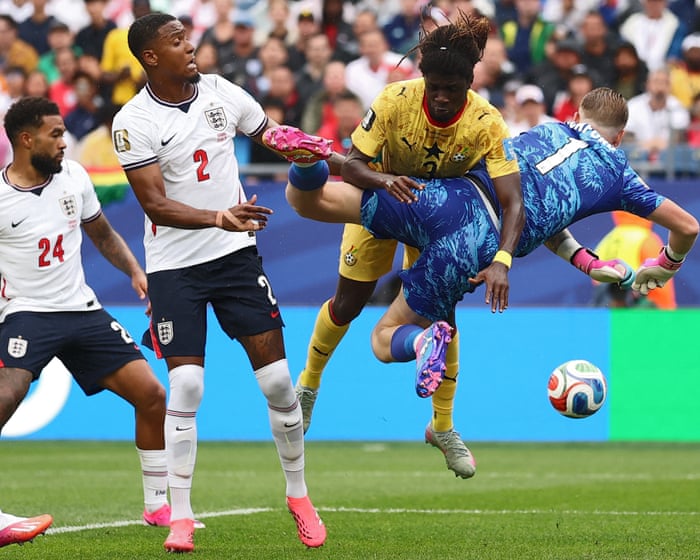
The flashpoint occurred when a dangerous, lofted ball swerved into the England penalty area, forcing Pickford to abandon his line in a desperate attempt to claim possession. In a moment of frantic action, the goalkeeper lunged into a collision with the incoming Ghana forward. Ghana’s players swarmed the referee, demanding an immediate spot-kick, but the official—after a tense, prolonged VAR review—waved play on.
While the game finished 0-0, the tension only intensified after the final whistle. New broadcast angles and high-definition VAR footage began circulating on social media, showing clear contact between Pickford and the forward. The visual evidence, which appeared to contradict the on-field decision, sent the internet into a frenzy.
Carlos Queiroz: “We Feel Disappointed”
Ghana manager Carlos Queiroz did not mince his words during his post-match press conference. The experienced coach, visibly fuming, questioned the integrity of the technology that is supposed to assist—not hinder—the game.
”I respect referees because their job is extremely difficult,” Queiroz stated. “But today our players feel disappointed. We believe there was enough evidence to award a penalty. When players, coaches, and millions watching all see the same thing and still do not understand the decision, then questions will naturally be asked.”
Queiroz’s critique extended beyond this single incident, taking aim at the systemic lack of consistency in how VAR is applied across the tournament. “VAR exists to eliminate clear and obvious mistakes,” he added. “If technology cannot provide clarity in moments like this, then people will understandably lose confidence in the process.”
FIFA’s Emergency Defense
The outcry became so deafening that FIFA was forced to break its silence, releasing an official statement to explain why the penalty was denied. According to football’s governing body, the decision wasn’t just a subjective choice by the referee; it was backed by “semi-automated tracking data.”
FIFA claimed that high-frame-rate cameras and ball-tracking technology proved Pickford made “clear contact” with the ball a fraction of a second before colliding with the Ghana player. Under the current interpretation of IFAB laws, if a goalkeeper makes a genuine attempt to play the ball and the subsequent collision is deemed “unavoidable,” it is not considered a foul.
The Debate That Won’t Die
Despite FIFA’s technical explanation, the controversy is unlikely to disappear. To many Ghana fans and neutral observers, the “ball-first” argument is a convenient narrative that ignores the reckless nature of the challenge. England supporters, meanwhile, are standing firm, pointing to the official ruling as proof of a correct, if high-stakes, decision.
As the tournament progresses, the Pickford incident will serve as a lightning rod for the ongoing struggle between human judgment and technological “clarity.” Whether FIFA’s explanation will satisfy the millions of fans who witnessed the drama in real-time remains to be seen. One thing is certain: with both teams still fighting for their lives in the group stage, this is far from the last time we will hear about the night the technology fell short of expectations. The controversy has ignited a fire that won’t be extinguished until the final whistle of the tournament.