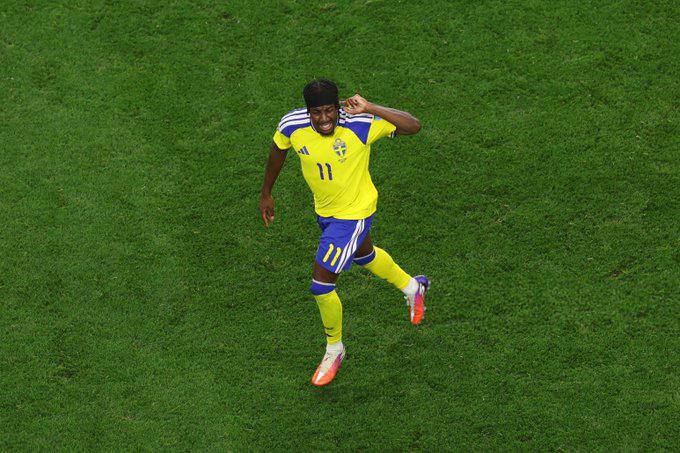
In a moment that will surely be remembered as one of the most surreal scenes of the 2026 World Cup, Sweden’s Anthony Elanga was left inconsolable on the pitch at full-time, convinced that his team had crashed out of the tournament. The reality? He had just helped secure the exact result Sweden needed to march into the knockout stages. The hilarious irony was only matched by the exasperated reaction of his manager, Graham Potter.
“Dear Me”: The Goal That Didn’t Feel Like A Winner
The drama unfolded following Sweden’s 1-1 draw with Japan. After Daizen Maeda opened the scoring for the Japanese side, it was Elanga who stepped up to rifle home a stunning equalizer. It was a goal of pure quality, the kind that usually signals a team’s ascent in a tournament. Yet, as the final whistle blew, Elanga collapsed to the turf, beating the grass in pure, unadulterated frustration.
While his teammates began to celebrate the news that their four points were enough to see them through as one of the best third-placed teams, Elanga remained slumped over, genuinely believing they were heading home.
”I just shouted: ‘Come on, we can go for more’. I’m glad we’re through, I didn’t know that at the end,” Elanga later admitted to Sportbladet.
Alexander Isak, Elanga’s Newcastle club teammate, wasted no time in “scolding” the winger for his stunning lack of situational awareness. But it was manager Graham Potter who stole the show. When informed of Elanga’s breakdown, Potter could only laugh off the absurdity of the situation.
”That explains a few things,” Potter told reporters. “We couldn’t have been clearer, but he was obviously thinking of something else. Bless him. I love him at the moment but, dear me.”
Potter’s Masterclass: A Tactical Shift to the Knockouts
Beyond the locker-room comedy, the draw proved that Potter’s tactical adjustments are beginning to pay dividends. After analyzing the defensive frailties shown in their previous match against the Netherlands, Potter made bold calls to shore up the structure. He brought in Jacob [likely referring to a goalkeeper selection] for his distribution, a move that proved vital in maintaining possession under Japan’s high press.
Potter’s post-match analysis also focused on the brilliance of Victor Gyokeres, who has become the linchpin of the Swedish attack. “I thought he [Gyokeres] was outstanding,” Potter remarked. “Outstanding performance for a back-to-goal centre forward. It’s just amazing.”
By playing a shape that allows the Arsenal striker to effectively partner with Isak, Sweden has discovered a tactical balance that makes them a dangerous prospect heading into the final 32. Potter’s ability to get his players to absorb complex tactical information on the fly has been the hallmark of Sweden’s journey so far.
The Road Ahead: Sweden as the Dark Horse?
It is a rare day when a player doesn’t know his own team’s qualification status, but for Sweden, the “Elanga Incident” might just be the moment that galvanizes the squad. There is a palpable sense of unity and “active organization” within the camp, with every player buying into Potter’s vision.
Whether it was a lack of focus or simply the intensity of the moment, Elanga’s confusion is now a footnote in a successful qualification campaign. With the knockout stages looming, Sweden has shown they can defend, they can adapt, and they can produce moments of magic—even if their own goalscorer isn’t quite sure what the score means. One thing is certain: they will need to be a lot more aware of the scoreboard in the next round, or Graham Potter might just run out of patience. For now, however, the Swedish adventure continues, and the rest of the tournament has been warned: Sweden is through, and they’ve got plenty more to give.