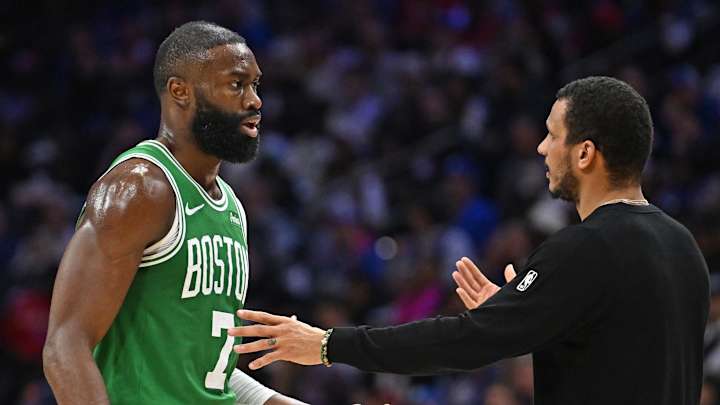
The NBA world is still reeling from the bombshell news that the Boston Celtics have officially parted ways with Jaylen Brown, shipping the 2024 Finals MVP to the Philadelphia 76ers in exchange for Paul George and a collection of draft assets. The immediate reaction from Boston fans and national pundits has been one of pure vitriol. Trading a superstar to a direct rival—one that just eliminated the Celtics from the postseason—feels like a betrayal of the championship window. But beneath the frustration and the “conspiracy theories” about secret motives, the reality of the situation is much colder and more clinical.
Brad Stevens didn’t make this move because of a hidden locker room rift or a secret injury. He made it because of a calculator.
The “Supermax” Ceiling: Why Boston Had to Pivot
At the heart of this decision is the harsh new reality of the NBA’s Collective Bargaining Agreement (CBA). Under the current financial landscape, teams are being squeezed by restrictive salary caps and luxury tax penalties that make building a deep, balanced roster nearly impossible if you tie up your entire cap in just two players.
Brown’s current supermax contract—which is set to pay him over $180 million over the next three seasons—was rapidly becoming the Celtics’ biggest liability. When you add in the fact that he would be eligible for a massive extension this October, the front office was staring down a future where Jayson Tatum and Brown would account for a staggering 70% of the team’s total salary cap.
The data-driven minds in Boston’s front office came to a blunt conclusion: they could not build a championship-level roster around two players consuming that much of the cap space. Stevens decided that if they were ever going to win another title, they couldn’t afford to have their “second option” paid like the greatest player in the game. It was a cutthroat, calculated decision to break up the supermax duo before the contract became “underwater” and untradable.
The Paul George Gamble: Flexibility Over Star Power
Critics are rightfully pointing out that Paul George is not on the same level as the prime-era Jaylen Brown. However, the Celtics weren’t looking for a direct “talent swap.” They were looking for financial oxygen.
George’s contract is far more palatable in the short term. With a player option for next season, he represents a flexible, two-year commitment rather than a long-term anchor. At worst, Boston has acquired a massive, $50+ million expiring contract that they can use next summer to hunt for a different kind of star or to clear space for a total re-tooling. By bringing in four valuable draft picks alongside George, the Celtics have successfully pivoted from a rigid, “two-star” model to a flexible, asset-rich approach.
Is This the End of the Dynasty?
Whether this move works out depends entirely on the “next wave” of roster moves. Stevens has effectively bet his tenure on the idea that Jayson Tatum can carry a team—and that a more balanced, deeper supporting cast is more valuable than two ultra-expensive individual stars.
It is a high-stakes gamble that will either be remembered as the smartest financial maneuver in modern NBA history or a tragic overcorrection that cost the Celtics a potential dynasty. For now, the dust is still settling. The era of Tatum and Brown is officially over, and the Boston front office has made their choice: they would rather build a team designed for longevity in the new CBA era than continue trying to force a supermax pairing that the numbers simply didn’t support.
The question remains: was moving Brown the final nail in the coffin, or was it the necessary surgery that saved the Celtics’ future? We’ll find out when the season kicks off. Until then, Boston fans are left to wonder if the “basketball reasons” cited by the front office are truly enough to justify the price of a championship-caliber departure.