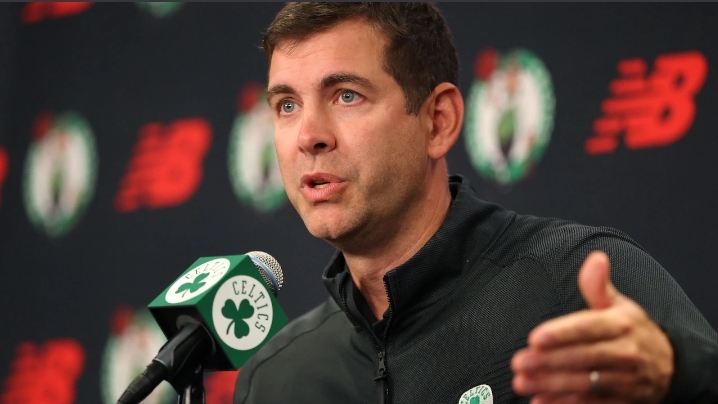
The “Aha!” moment never arrived. For 45 grueling minutes, Celtics President of Basketball Operations Brad Stevens and principal owner Bill Chisholm stood before the media, attempting to justify the unthinkable: the trade of Jaylen Brown to the Philadelphia 76ers. If you were a Celtics fan hoping for a logical explanation, a tactical masterstroke, or even a glimmer of “championship-level” reasoning, you walked away disappointed, frustrated, and—quite frankly—insulted.
The “Optionality” Buzzword Disaster
The core of Stevens’ justification rested on a single, repetitive term: “optionality.” He used the word 11 times during the press conference, a frequency that felt less like a strategic explanation and more like a desperate attempt to manufacture a new front-office mantra. Stevens argued that after back-to-back early playoff exits, the front office determined that having two stars (Brown and Jayson Tatum) account for 70% of the salary cap was a “challenging path” that prevented long-term success.
It is a justification that smells eerily like the “roster flexibility” excuse used by the Red Sox during their infamous fire sale of Mookie Betts. When a front office starts preaching “optionality” over the retention of an All-NBA talent, the fanbase is usually right to suspect that the championship window is being boarded up.
The Internal Contradiction
The logic falls apart under the slightest scrutiny. Stevens claimed that the salary cap burden of two stars was the issue—yet this entire trade saga began with the Celtics’ aggressive pursuit of Giannis Antetokounmpo. Had that deal materialized, Giannis and Tatum would have occupied that exact same percentage of the cap, effectively rendering the “optionality” argument moot.
Furthermore, Stevens’ claim that the market for Jaylen Brown wasn’t “robust” rings hollow. Even if the market was soft, the Celtics weren’t under a contractual mandate to move him. The deal they accepted—taking on the oft-injured, 36-year-old Paul George, whose contract is widely considered one of the five worst in the NBA, in exchange for a paltry package of two first-round and two second-round picks—is, by any objective measure, a nightmare.
Why the Rush?
The most baffling aspect of the entire affair is the urgency. Stevens admitted that trading Brown to a fierce division rival kept him “up at night.” If it caused that much psychological turmoil, why not simply… sleep? Why not wait? It is highly improbable that the 76ers would have rescinded that offer on July 1st, or August 1st, or even at the trade deadline. By acting now, the Celtics have potentially gutted their own championship viability for a package that even rival general managers have described as “baffling.”
One anonymous GM told ESPN, “The guy got traded for less than Walker Kessler. That’s baffling to me. I’m surprised they felt so forced to do it right now—to Philly and for that package! I’m shocked.”
The Verdict: Coaching or Cap?
The Celtics were not a “broken” team last season. They were a few tactical adjustments and a healthier Jayson Tatum away from being legitimate title contenders. If the team struggled in the postseason, it was arguably a result of coaching stubbornness, not a lack of “optionality.”
By shipping out Brown, the Celtics haven’t just cleared cap space—they have removed one of the premier wings in the sport and replaced him with the deteriorating health and massive contract of Paul George. Fans are left to wonder if the front office has traded a championship-caliber core for the sake of a spreadsheet.
The “optionality” argument is a cold, corporate, and ultimately unconvincing defense for one of the most lopsided trades in recent NBA history. If Brad Stevens wanted to restore faith in the Celtics’ basketball future, he needed a lot more than a buzzword to do it. He needed a plan—and right now, that plan looks like a recipe for a long, painful rebuild.