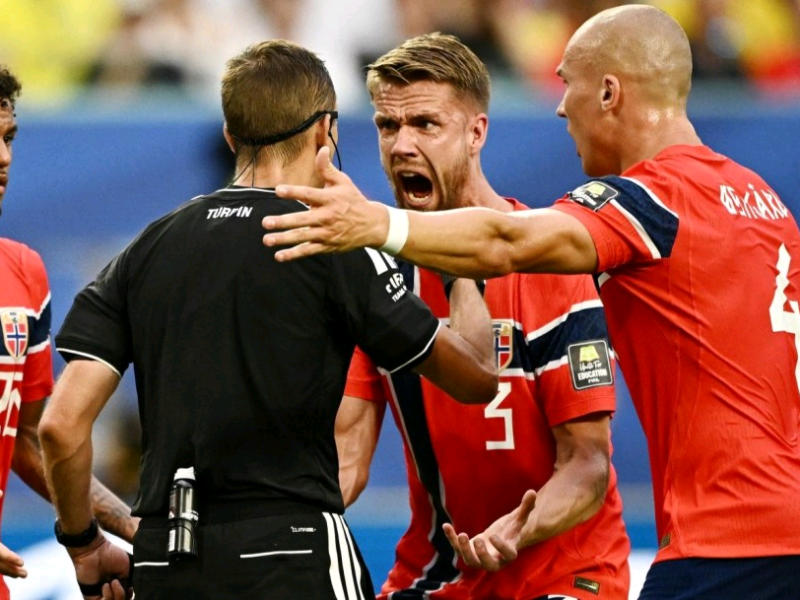
The 2026 World Cup has officially been rocked by its most contentious officiating scandal to date. Following England’s dramatic 2-1 quarter-final victory over Norway—a match defined by high-intensity drama and bitter officiating disputes—FIFA has finally felt the heat of global outrage, releasing a formal statement that has only served to fuel the fire among millions of frustrated fans.
The Moment That Stopped the World
The controversy revolves around England’s crucial first-half equalizer. With Norway holding a 1-0 lead and dominating the pitch, Jude Bellingham sliced through the Three Lions’ opponents to level the score just before half-time. However, the goal was immediately mired in suspicion. Television replays broadcasted to a global audience appeared to show the ball striking an overhead “spider-cam” cable mid-flight, causing a sudden, unnatural dip that completely wrong-footed the Norwegian defense.
Under the standard Laws of the Game, if the ball hits an external stadium object, play must stop immediately, followed by a neutral drop ball. Because the referee allowed the game to continue, the goal stood, and England snatched the momentum that would eventually carry them into the semi-finals.
The FIFA Defense: The “Heartbeat” Sensor
In a rare move to regain control of the narrative, FIFA’s official account released a technical breakdown of the incident, leaning heavily on their high-tech “Adidas Connected Ball” system. According to the governing body, the internal sensor—which tracks the ball’s motion in real-time—showed absolutely no “peak” or anomaly.
”The sensor in the Connected Ball showed no peak in the ‘heartbeat of the ball’ while in the air,” FIFA stated, effectively dismissing claims that the ball touched any overhead equipment. They asserted that because the sensor detected no irregular impact, there was no legal basis for VAR to step in.
This same technology has been the pride of this tournament, famously used earlier to rule out a potential Croatia goal by detecting a single hair grazing the ball. Yet, fans across social media are now asking the obvious question: if the ball didn’t hit the cable, what caused that sudden, gravity-defying drop in mid-air?
A Tournament Under Scrutiny
The frustration for Norway is twofold. Not only did the “cable goal” stand, but the team later saw what looked like a legitimate go-ahead goal wiped off the board by VAR, with officials ruling that Erling Haaland had committed a foul in the build-up. The combination of these two decisions has left the Norwegian camp—and its massive, passionate fanbase—convinced they were the victims of a systemic bias against the “smaller” footballing nations.
The backlash has been so severe that reports are now surfacing suggesting FIFA has been forced to launch an official internal investigation into the performance of the VAR team during the quarter-final. The pressure on Thomas Tuchel and the England squad is mounting as they prepare for the semi-finals, while the “Cablegate” debate continues to dominate headlines worldwide.
What Happens Now?
As Norway prepares to pack their bags and head home, the conversation has moved far beyond the result. This is no longer just about who is going to the semi-finals; it is about the integrity of the technology we rely on to judge the world’s biggest games. Can we trust machines that contradict what millions of eyes see on television?
FIFA is attempting to lean on data to end the conversation, but for the millions of viewers who watched the ball dip unnaturally in Miami, the “truth” is far from settled. As the 2026 World Cup marches toward the final, one thing is certain: this tournament will be remembered for the moment when technology promised to solve everything, but instead created the biggest controversy in the history of the sport.
Football fans: Do you believe FIFA’s sensor data, or did you see the ball hit the cable with your own eyes? Is this the moment we finally realize we’ve gone too far with technology in football? Let us know your thoughts in the comments below!