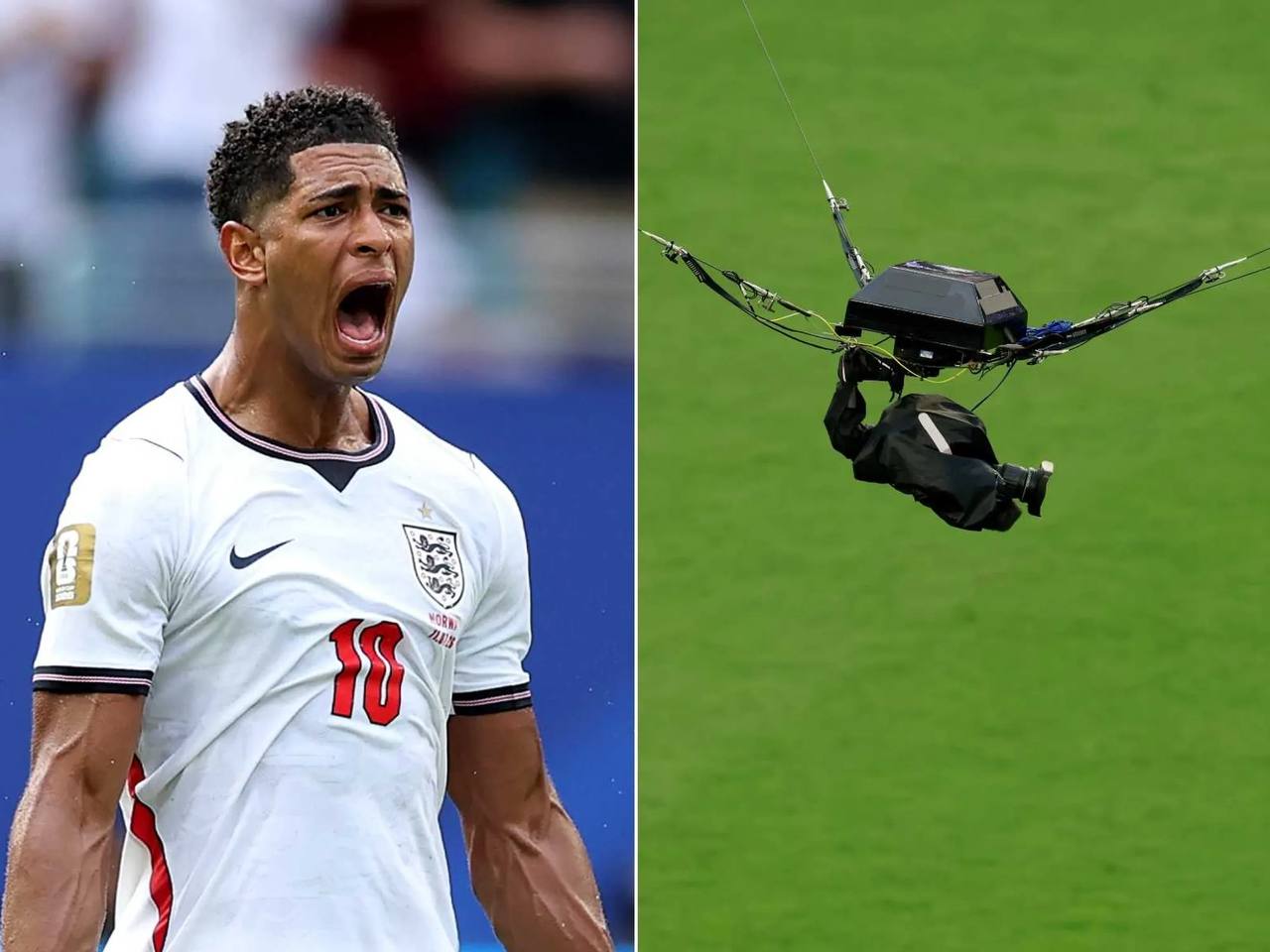
The quarter-final drama between England and Norway continues to dominate the global football conversation, and just when we thought the dust had settled, a new viral revelation has poured gasoline on the fire. The focus? That contentious Jude Bellingham equalizer. A new 3D replay broadcast by BBC Sport has gone viral, with thousands of fans claiming it provides “smoking gun” evidence that England’s vital goal should have been ruled out.
The 3D Footage That Shook the World
The footage, which has been shared millions of times across social media, appears to show the ball’s trajectory shifting unnervingly during Norway goalkeeper Ørjan Nyland’s goal-kick. To the naked eye—and certainly to the millions of aggrieved Norway fans—it looks exactly like the ball clipped the overhead spidercam cable.
If true, this would be a catastrophic officiating oversight. Under FIFA’s strict rules, any contact with overhead equipment necessitates an immediate dead-ball situation, a whistle from the referee, and a restart via a drop ball. With the viral 3D angle seemingly showing a “flick” in the air, the online consensus shifted rapidly: England’s equalizer was an illegal goal, and Norway’s World Cup dreams were stolen by a wire.
VAR Expert Dale Johnson Breaks Silence
As the outrage reached a fever pitch, BBC Sport’s own VAR expert, Dale Johnson, stepped in to calm the storm. Johnson took to the airwaves to systematically dismantle the viral theory, cautioning fans that 3D replay systems are not infallible.
”This is not true,” Johnson stated, pointing to the sophisticated data tracking now standard at the 2026 World Cup. He explained that the stadium is equipped with 16 dedicated antennas tracking the ball’s signal from beneath the roof. The “heartbeat of the ball” technology—a sensor that tracks every micro-movement and rotation—showed no sudden impact or deviation.
Johnson further dismantled the clip by noting: “The cable cam footage doesn’t shake or move. Plus, the wave detected in the flight is just the natural path of a ball travelling through the air.” He even pointed to historical precedents where 3D replay systems had previously misinterpreted ball physics, essentially telling the public that what they were seeing was an optical illusion, not a scandal.
FIFA’s Data vs. The “Eye Test”
FIFA has remained steadfast in its defense of the goal. Following the match, they released internal data confirming that the sensor inside the official match ball recorded zero contact with the overhead wire. According to FIFA, the evidence is empirical, absolute, and beyond reproach.
For the Norwegian side, however, the technical data is cold comfort. The match officials on the day found no reason to consult the monitor, and VAR saw nothing to suggest the game had been compromised. As far as the governing body is concerned, Jude Bellingham’s strike was a perfectly valid piece of individual brilliance that ultimately proved to be the difference between a semi-final appearance and a flight home.
The Verdict: Fact or Fiction?
The BBC’s viral clip has sparked a fascinating debate about the role of technology in the modern game. It highlights an uncomfortable reality: even as we move toward a future where sensors and antennas track every millisecond of a match, fans will always trust their “eye test” over a computer readout.
England advances to face Argentina in what is shaping up to be the biggest match of the tournament. The “Ghost Goal” controversy will surely follow them to the next round, but for now, the records will show that the goal stood. Was it a miracle of physics, or a technological failure? One thing is certain: in the world of the 2026 World Cup, there is no such thing as a quiet win.
Football fans: The technology says it’s clear, but the 3D replay says otherwise. Do you trust FIFA’s sensors, or are you convinced that England got the luckiest break in World Cup history? Tell us what you see in the comments below!