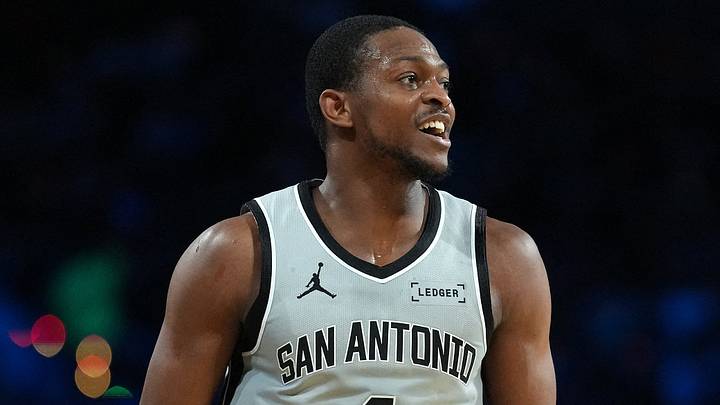
When San Antonio traded for De’Aaron Fox, the assumption was simple: he’d slide in as Victor Wembanyama’s clear co-star, the unquestioned second option on a team built around its generational young star. His max contract certainly reinforced that narrative. But the reality that’s actually played out on the court tells a very different — and surprisingly encouraging — story.
The Numbers Don’t Lie
Dig into the data, and it becomes clear Fox has quietly settled into life as San Antonio’s third option, not its second. He did carry the second-highest field goal attempts per game during the regular season, but it was sophomore guard Stephon Castle who posted the higher usage rate, initiating the offense more frequently and dominating a larger share of possessions. The gap was modest during the regular season (24.3 to 24.2), but it widened noticeably in the playoffs (24.5 to 22.3), signaling this wasn’t just statistical noise — it was a real shift in how the Spurs’ offense actually operated when the stakes rose.
Why This Arrangement Actually Works
Rather than dominating the ball, Fox has largely found his shots within the natural flow of San Antonio’s offense — and it worked. With just one full season of continuity under this current core, the Spurs have every reason to lean further into this setup going forward, especially with egos seemingly taking a backseat to winning.
Heading into the offseason, Fox now has something valuable he didn’t have a year ago: genuine experience navigating this exact system. That kind of continuity matters enormously for a speedy, downhill-oriented guard learning to operate as a complementary piece rather than a primary engine.
A Solid First Year, With Room to Grow
To be fair, Fox’s 2025-26 campaign was genuinely productive — he averaged 19 points on 49% shooting from the field. His three-point shot cooled off noticeably in the back half of the season, but outside of that, he remained efficient and effective within his role. Still, there’s clear room for further growth as he continues adjusting.
History Backs This Transition Up
This kind of adjustment period isn’t unprecedented, and past examples suggest better days could be ahead. Chris Bosh went from being the primary option in Toronto to a complementary piece alongside LeBron James and Dwyane Wade in Miami — solid in year one, but he didn’t fully settle into that new role until his second full season. Kevin Love followed a nearly identical path, transitioning from Minnesota’s franchise cornerstone to Cleveland’s third option behind LeBron and Kyrie Irving. In both cases, it wasn’t a decline in talent — it simply took time to fully adapt from being “the guy” to becoming one crucial piece within a bigger machine.
Not the Sacramento Version — A Better Fit for San Antonio
The key distinction here is that the Spurs don’t need Fox to replicate his Sacramento role, where he essentially carried the franchise on his own. What they need is the best possible version of Fox within their system — a slightly different, but potentially more sustainable, path to winning. With Castle continuing to develop and take on an even larger share of playmaking responsibility, Fox should benefit from more space and cleaner looks generated by the offense around him, rather than needing to manufacture everything himself.
What to Expect Next Season
With a full offseason to fully embrace this new reality, don’t be surprised if Fox returns looking noticeably more comfortable — and, by extension, more dangerous — as San Antonio’s third option. Sometimes stepping back from center stage is exactly what allows a player to thrive within a genuinely powerful team.