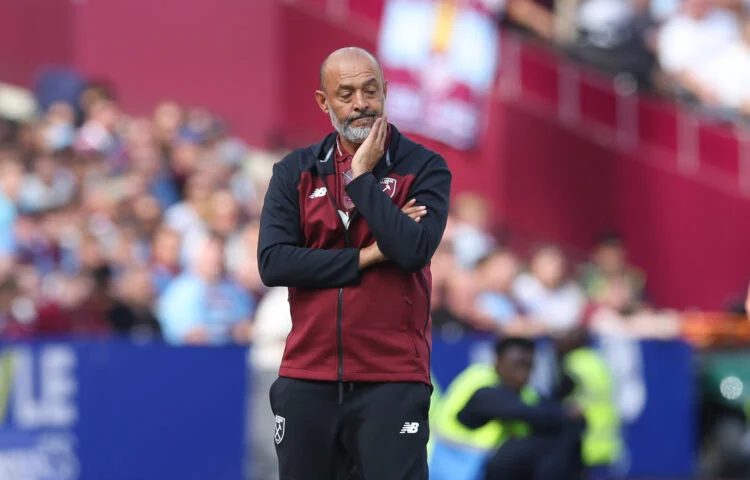
West Ham United’s quest to bounce back has hit a staggering, early-season speed bump. In what was supposed to be a straightforward home fixture, the Hammers suffered a shocking 2-1 defeat at the hands of Charlton Athletic on Saturday afternoon—leaving supporters stunned and raising serious questions about the direction of the club under manager Nuno Espirito Santo.
Ironically, Nuno finally got his wish regarding one key tactical metric: dominance in possession. Unfortunately, the disastrous result proved precisely why trying to reinvent the wheel might be the biggest mistake of his managerial career.
The Possession Paradox: Dominating the Ball, Losing the Match
Throughout his managerial career, Nuno has never been known for orchestrating long, patient spells of keep-ball. Whether guiding Wolverhampton Wanderers or Nottingham Forest into European contention, his trademark success always relied on a compact, defensive block and blistering, rapid-fire counter-attacks powered by speed merchants like Adama Traore and Anthony Elanga. His brief, ill-fated stint at Tottenham proved that forcing him into a passive, possession-heavy shell simply does not work.
Yet, ahead of the new campaign, Nuno publicly acknowledged that West Ham would need a different approach. Recognizing that opponents would sit deep and treat the Hammers as the scalp to claim, he insisted the team must evolve.
“We have to approach each game differently,” Nuno told BBC Radio 5 Live. “Every team will look at us as the team to beat. So, in terms of football, you have to have a dominant game. [We need to be able to] control more of the ball. Hopefully, we can increase our levels of possession threat.”
The summer arrivals of Arne Engels and Manor Solomon were meant to turn that vision into reality. But against Charlton, the flaws of that transition were laid completely bare. West Ham monopolized a staggering 78 per cent of the possession, completing 644 passes compared to the Addicks’ meager 163. Yet, despite that overwhelming territorial dominance, Charlton ruthlessly converted their 22 per cent share of the ball into a stunning 2-1 away victory at the London Stadium.
Why Experts Warned Against Nuno’s Tactical Shift
Recognizing a problem and possessing the tactical toolkit to fix it are two entirely different beasts. Long before Saturday’s humiliation, EFL expert George Elek sounded the alarm bells on the Not the Top 20 podcast, labeling Nuno’s desire to dominate possession a “massive, massive red flag.”
Elek pointed out that modern successful teams—such as those coached by Marcelo Bielsa, Daniel Farke, Enzo Maresca, Marco Silva, or Vincent Kompany—win promotion and titles by pinning opponents back and breaking them down with meticulous positional patience and high-pressing intensity.
Nuno, by contrast, has never built a team that plays that way. Even when he captured the Championship title with Wolves back in 2017 with an absurdly talented roster featuring Ruben Neves, Diogo Jota, and Conor Coady, they only managed a 54 per cent possession average, heavily relying on individual brilliance and transitional speed rather than positional suffocation.
As Elek astutely argued:
“Nuno was manager of one of the best Championship teams ever… [but] if you look at recent history of the Championship, the Championship has changed. Teams that have won the league in the last few seasons, they all play ball-dominant, high-pressing football… [And] there’s nothing in his managerial career to suggest that’s the way that he wants to play.”
Pressure Mounts at the London Stadium
Saturday afternoon proved that simply forcing a reactive coach into a proactive, possession-dominant style creates a disjointed, toothless outfit. West Ham had the ball on a string, but they had zero tactical answers when faced with a disciplined, low-block defense.
The evidence is rapidly stacking up against Nuno Espirito Santo. If the Hammers hierarchy truly expects a progressive, modern style of play to navigate the grueling English lower tiers back to the promised land, they may soon have to ask themselves a brutal question: is Nuno the right man to lead the revolution, or has he been handed a tactical assignment he simply isn’t equipped to solve?