As the dog days of the NBA offseason roll on, late-August transactions rarely bring true blockbuster fireworks. Instead, the focus shifts to how the shifting financial landscape impacts around-the-league spending. Recent bargain deals for talented restricted free agents—such as Bennedict Mathurin heading to the New Orleans Pelicans on a two-year, $16 million contract and Jonathan Kuminga joining the Minnesota Timberwolves on a two-year, $13 million deal—have sent shockwaves through basketball circles.
While these discounted contracts highlight a broader league trend where young, ascending talents fail to command the massive open-market checkbooks they once might have, they also serve to shine an uncomfortable spotlight on past financial missteps. For no team is this sting more acute than the Toronto Raptors, whose historical cap decisions continue to restrict their flexibility.
The Immanuel Quickley Conundrum in Hindsight
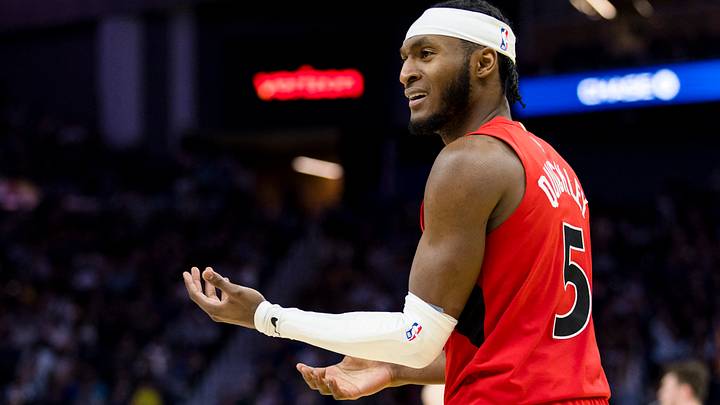
Every summer that passes makes the Toronto Raptors’ 2024 commitment to Immanuel Quickley look heavier on the books. When the front office locked in their young guard to a massive five-year, $162.5 million extension, the intention was clear: reward a cornerstone piece and secure the future of the point guard position.
At the time, Toronto operated without serious competitive bidding for Quickley’s services, making the massive financial commitment a high-risk gamble. As subsequent offseasons have proven, exercising patience with restricted free agents or leveraging market coldness typically yields significantly better team-friendly terms.
For comparison, look at recent mid-tier market benchmarks. Josh Giddey settled into a much more palatable four-year, $100 million deal with the Chicago Bulls, while Ayo Dosunmu secured a five-year, $112 million extension with Minnesota. Stacked against those numbers, Quickley’s $32.5 million annual average salary feels increasingly restrictive, especially for a franchise constantly fighting to maximize its financial flexibility.
To be fair, nobody can fault Quickley and his representatives for capitalizing on a max-level offer handed to them on a silver platter. Nor is it entirely fair to discount Quickley’s raw talent or potential. However, had Toronto’s front office anticipated how tightly the market would clamp down on young guards in subsequent years, they might have approached negotiations with considerably more leverage.
Squeezed Finances and the Road Ahead for Toronto
Compounded by other questionable historical extensions—such as Jakob Poeltl’s pricey deal—the Quickley contract leaves Toronto cornered financially. With a payroll locked up across multiple pieces, the Raptors frequently find themselves lacking the breathing room needed to maneuver freely on the trade market or absorb top-tier salaries without completely tying their own hands.
Despite the financial headache, hope remains high in Raptors Nation. With superstar forward Kawhi Leonard expected to enter the fold via trade and the Eastern Conference landscape wide open, Toronto possesses the pieces to make significant noise.
If Quickley can bounce back, elevate his production, and completely justify his lucrative paycheck alongside Leonard and Scottie Barnes, past financial over-indexing will quickly be forgiven. Alternatively, if the fit continues to raise internal questions, the front office could ultimately be forced to explore using his massive salary as a matching piece in a blockbuster trade—such as orchestrating a splashy move for a veteran floor-general like Kyrie Irving.
As training camp approaches, the burden of proof rests squarely on Quickley’s shoulders to prove he is worth every single penny of his historic deal.
What do you think of Immanuel Quickley’s contract? Are the Raptors doomed by his salary, or will he prove his worth this season? Let us know your thoughts in the comments below!