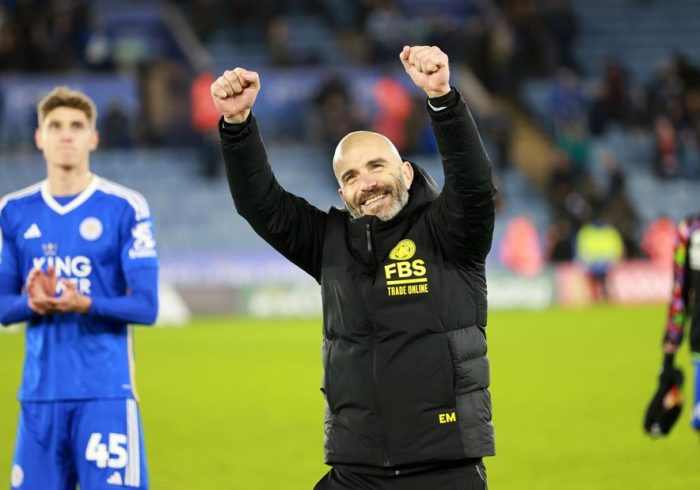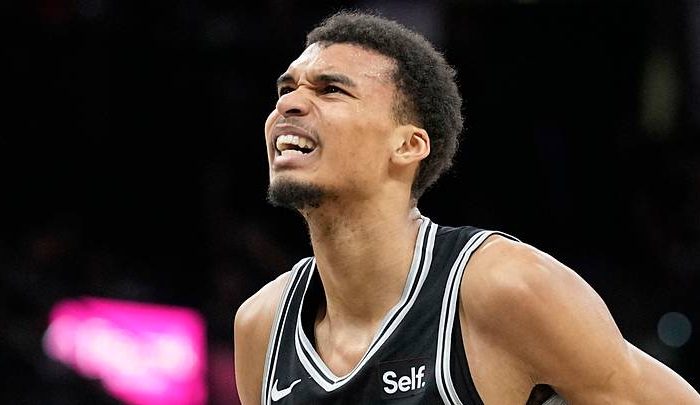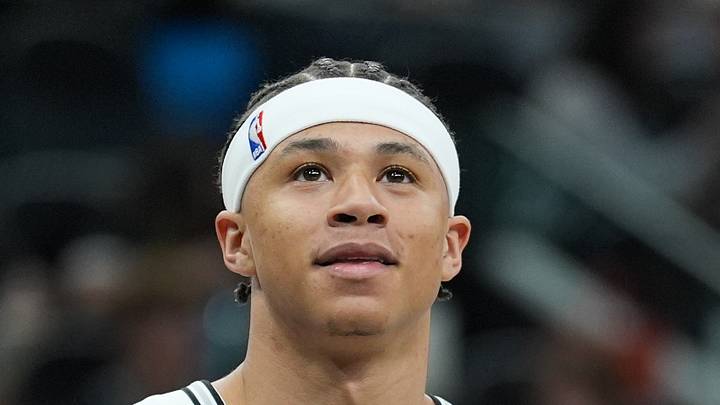
The San Antonio Spurs have no shortage of young talent, but finding enough minutes for all of it could become one of the biggest challenges facing Mitch Johnson this season.
And Carter Bryant may have an unconventional solution.
The 20-year-old forward could have a difficult time breaking into San Antonio’s regular rotation if the Spurs continue using their established players in traditional roles. However, there is one intriguing way the coaching staff could get Bryant onto the floor more consistently: turning him into a small-ball center whenever Victor Wembanyama leaves the game.
It might sound unusual at first.
Bryant stands only 6-foot-6 and entered the league as a forward, but his physical profile and developing skill set could make him an interesting option at the five. More importantly, the move could solve two problems at once — giving Bryant valuable development minutes while allowing the Spurs to maintain a faster, more versatile lineup.
San Antonio has already added veteran forward Tobias Harris, while Devin Vassell, Julian Champagnie and Keldon Johnson are also expected to command significant minutes. That creates a serious logjam on the wing and at power forward.
Rather than leaving Bryant stuck at the end of the bench, Johnson could experiment with him as a small-ball five.
Why Carter Bryant could make sense at center
The biggest requirement for a small-ball center is not necessarily height.
It is versatility.
Bryant has the physical tools to handle the role. At around 220 pounds, he possesses enough strength to battle bigger players while also having the mobility to defend quicker opponents. That combination could become particularly valuable when San Antonio wants to spread the floor and force opposing big men into uncomfortable situations.
The Spurs could essentially create a five-out offensive system around Bryant.
If Wembanyama is on the bench, Bryant could occupy the middle while four shooters surround him. That would create driving lanes, increase spacing and potentially make life considerably easier for players such as De’Aaron Fox, Stephon Castle and Dylan Harper.
There is still one obvious question.
Can Bryant shoot well enough to make opponents respect him?
His three-point numbers were not spectacular during his rookie season, when he shot 33.5 percent from deep. But there was an encouraging improvement after the All-Star break, when his accuracy climbed to 35.1 percent.
If that upward trend continues, the Spurs could have something genuinely interesting on their hands.
The Luke Kornet situation could open the door
Another factor working in Bryant’s favor is the presence of Luke Kornet.
Kornet remains a useful traditional backup center. He can protect the rim, rebound and provide size, but his limitations become more obvious when opponents play smaller and faster.
That is exactly where Bryant could provide an alternative.
A mobile five could allow San Antonio to switch more aggressively defensively while creating significantly more space offensively. Instead of asking Kornet to survive against small lineups, the Spurs could counter with Bryant and attempt to turn the matchup into an advantage.
It would not mean Bryant suddenly becomes a full-time center.
Rather, the role could be deployed selectively depending on the opponent.
Against teams with slower power forwards or smaller frontcourts, Bryant could spend stretches at center and give the Spurs an entirely different look.
But Bryant still has plenty to prove
The opportunity will not simply be handed to him.
Bryant played only 11.5 minutes per game across 71 appearances during his rookie season, so earning a bigger role will require significant improvement.
His shooting must become more reliable. His rebounding needs to improve. Most importantly, he has to demonstrate that he can defend without becoming a target for opposing offenses.
The Spurs also have legitimate reasons to prioritize experienced players.
Harris and Johnson are likely to receive substantial minutes, while Vassell and Champagnie remain important pieces of the rotation. Harrison Barnes also provides veteran experience, even if his athleticism is no longer what it once was.
That leaves Bryant fighting for limited opportunities.
But that is precisely why the small-ball center experiment could be so valuable.
Instead of competing exclusively with other forwards, Bryant could carve out a unique role that nobody else on the roster perfectly replicates.
San Antonio cannot afford to waste Bryant’s development
The Spurs are no longer simply building for the future.
With Wembanyama leading a talented young core that includes Fox, Castle and Harper, expectations are rising rapidly. San Antonio wants to compete at the highest level, meaning every rotation decision becomes increasingly important.
At the same time, the franchise cannot afford to stunt the development of its young players.
Bryant was selected 14th overall in the 2025 NBA Draft for a reason. The Spurs clearly saw long-term potential in him, and now they need to find a pathway toward unlocking it.
Using him as a small-ball five could provide exactly that pathway.
It would give Bryant opportunities to shoot, rebound, defend, handle the ball and make decisions in space. Those are precisely the types of responsibilities that could accelerate his development.
And if the experiment works, San Antonio could suddenly have another versatile weapon for the postseason.
The biggest question facing Mitch Johnson may therefore not be whether Carter Bryant deserves minutes.
It may be whether the Spurs are willing to think differently enough to find them.
With Wembanyama anchoring the starting lineup, Bryant could eventually become the unconventional small-ball solution San Antonio didn’t know it needed.
For a team chasing a championship, that could prove to be a very important discovery.