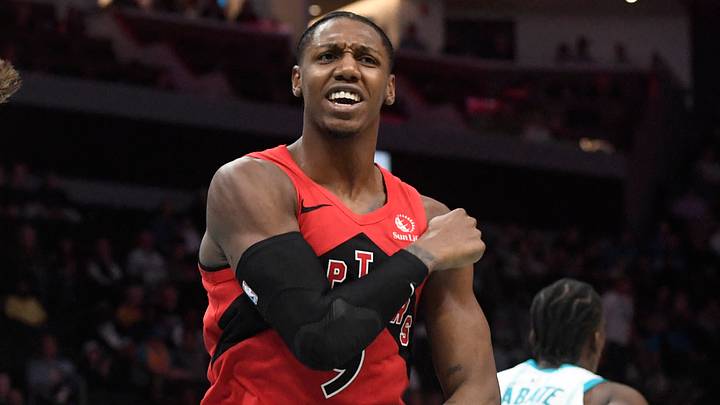
The Toronto Raptors could be heading into one of the most intriguing seasons in recent franchise history, but an uncomfortable question surrounding RJ Barrett may become impossible to ignore.
Barrett remains an important part of Toronto’s plans heading into the 2026-27 campaign. The 26-year-old has established himself as one of the team’s most productive scorers, and his strong showing during the 2026 playoffs only strengthened his case. Yet despite that impressive postseason, uncertainty remains over whether Barrett is truly the ideal long-term piece for the version of the Raptors the organization is trying to build.
That question has become even more relevant with Toronto’s major offseason ambitions and the ongoing buzz surrounding a potential Kawhi Leonard return.
Barrett’s situation is particularly fascinating because this is not a case of a player suddenly becoming unwanted. Quite the opposite. He has consistently shown his ability to create offense, attack the basket and take responsibility when the Raptors desperately need production.
The problem is whether those strengths remain as valuable if his role changes.
Toronto appears to be assembling a team built around defensive versatility and length. A potential core featuring Kawhi Leonard, Scottie Barnes and Collin Murray-Boyles could give the Raptors an intimidating defensive identity, while players such as Jamal Shead, Ja’Kobe Walter, Allen Graves and Kyle Anderson could further strengthen that side of the roster.
But there is another ingredient Toronto desperately needs: shooting.
And that is where Barrett becomes a complicated fit.
Barrett’s scoring is not the problem
There is little question that Barrett can score.
During Toronto’s recent playoff run, he demonstrated exactly why the Raptors have valued him. When the team lost key offensive pieces, Barrett stepped into a larger role and showed that he could carry significant responsibility.
However, the circumstances could be very different if Leonard joins the picture.
Barrett would potentially have fewer opportunities to dominate the ball, meaning his value could increasingly depend on how effectively he contributes without needing constant touches.
That raises a crucial question: Can Barrett become the complementary player Toronto needs?
His three-point shooting may be the biggest concern.
Barrett attempted five three-pointers per game during the 2025-26 season but converted only 33.9 percent of them. His career mark from beyond the arc is 34.5 percent.
Those numbers are not disastrous, but they hardly make him the specialist shooter Toronto may require alongside its developing core.
That could become a serious issue if the Raptors want to maximize Barnes and their other key players.
The shooting problem could force Toronto’s hand
Sam Quinn of CBS Sports recently highlighted essentially the same concern while discussing Barrett’s future with Yossi Gozlan of the Third Apron Podcast.
Quinn suggested that Toronto could benefit from having another shooter occupying Barrett’s spot, arguing that the roster could use greater spacing and that Barrett may overlap with some of the team’s existing personnel.
That does not mean Barrett is a bad player.
It means the Raptors may need to ask a more difficult question: Is he the right player for what they are trying to become?
That distinction is extremely important.
A player can be talented, productive and popular while still being an imperfect fit for a particular roster.
Barrett’s ability to handle the ball and generate offense has been valuable for Toronto. But if Leonard arrives and Barnes continues to develop as a primary option, the Raptors could have multiple players who prefer having the ball in their hands.
In that scenario, a high-level catch-and-shoot threat could potentially provide more value.
Could a trade suddenly make sense?
That possibility puts Barrett’s expiring contract under an even brighter spotlight.
Rather than committing long-term money to a player whose role could become increasingly difficult to define, Toronto could potentially explore the trade market and search for a player who complements its defensive-minded core more naturally.
Several types of targets could make sense.
A player such as Max Strus could provide additional perimeter shooting. Rui Hachimura could offer size and scoring from the forward position. Cam Johnson would bring another proven shooting option.
There could even be an appetite for a much bigger swing, such as exploring a deal involving Trey Murphy III.
None of those possibilities means a trade is inevitable. Barrett could still prove that he can adapt, improve his shooting and thrive in a reduced but highly efficient role.
And that may ultimately determine everything.
The Raptors do not necessarily need Barrett to become a completely different player. They need to determine whether the player he already is can fit alongside the pieces they believe can take them back into genuine contention.
That makes the upcoming season enormously important.
Toronto has spent years searching for the next version of itself. Now, with the possibility of a dramatically improved core, the margin for error becomes smaller.
Barrett remains talented enough to be a major contributor.
But if his shooting remains inconsistent and his touches decrease, the Raptors may eventually have to confront a difficult reality: keeping him may not necessarily give them the highest possible ceiling.
For a franchise hoping to make a serious leap, that could be the decision that defines the next stage of the rebuild.