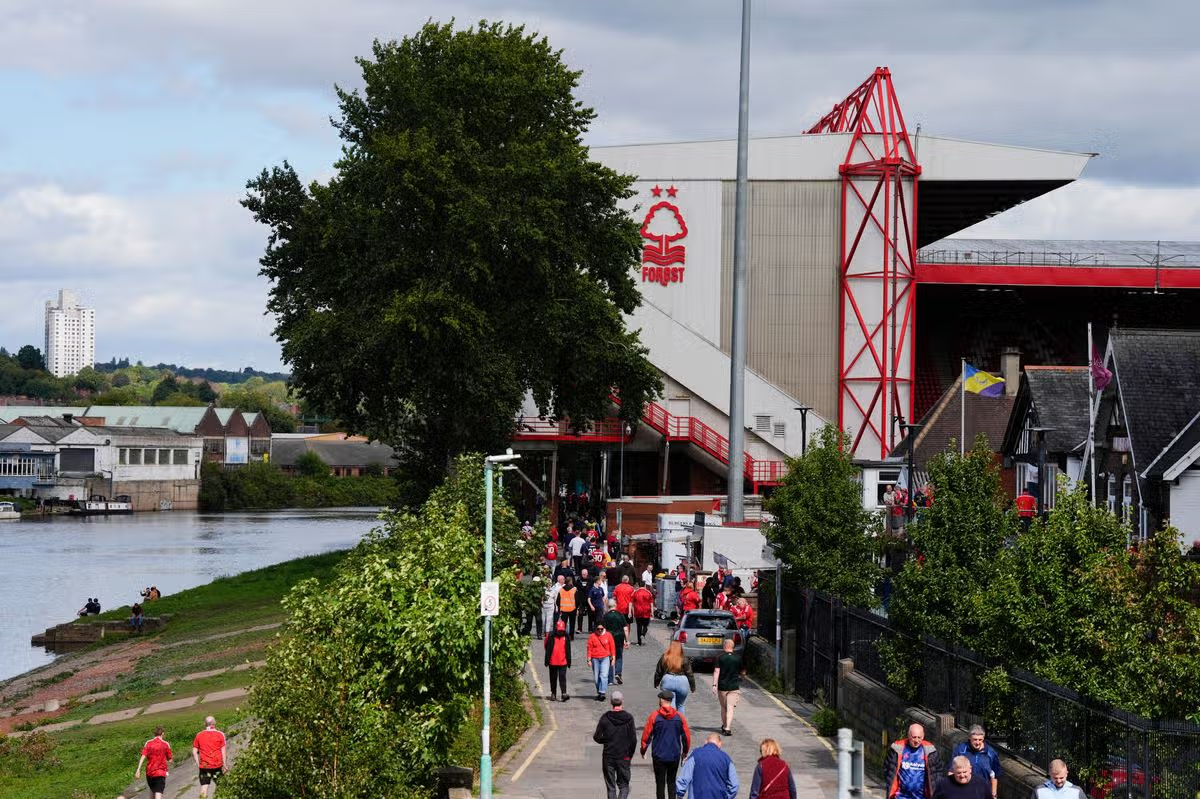
Nottingham Forest’s ambitious multi-million-pound vision to transform the historic City Ground into a world-class, 52,500-seater stadium is facing a defining moment. As club officials and supporters gear up for a crunch planning meeting on Wednesday, September 16, 2026, new details have emerged regarding the strict environmental conditions required to push the massive project across the finish line.
While the club’s dream of modernizing its iconic banks-of-the-Trent home has captured the imagination of fans since initial concepts were first floated back in 2019, turning vision into reality comes with significant logistical and environmental hurdles. Chief among them is a newly finalized agreement with the Environment Agency regarding comprehensive flood protection measures.
The Environmental Hurdle: Flood Defences and the Trent End
Because the existing Trent End already encroaches directly onto the River Trent’s riparian zone—the crucial ecological interface where water meets dry land—filling in both corners of the stand to boost capacity presents unique engineering challenges. The Environment Agency initially raised formal objections to the expansion plans due to concerns over a potential loss of channel capacity, which refers to the volume of water the river can hold within its banks before spilling over into surrounding areas.
However, those initial roadblocks have successfully been cleared following an agreement on specialized flood mitigation infrastructure. Under the new stipulations, Nottingham Forest will be legally required to construct a brand-new flood defence structure by the expanded stadium and assume full responsibility for its ongoing inspection, maintenance, and repair at their own personal cost for a period of 40 years.
The proposed defence must stand at 25.17 metres above sea level. Given that the local terrain already sits at approximately 23 metres, the physical structure itself will rise roughly two metres in height. Furthermore, the Environment Agency has noted a note of caution in its official reports, writing that while raising the structure further during the lifespan of the development is considered unlikely based on current data, future adjustments cannot be completely ruled out as climate models and flood risk assessments evolve.
Crunch Planning Meeting and Phased Construction Timeline
The upcoming Rushcliffe Borough Council planning meeting will determine the immediate fate of the initial development phase. Councillors will review plans designed to lift the stadium’s capacity from 30,000 to 45,000 by comprehensively extending the Peter Taylor Stand and filling in the corners of the Trent End.
Meanwhile, a secondary phase—aiming to push total capacity to 52,500 via an extension of the iconic Brian Clough Stand—is slated to receive outline approval on Wednesday, meaning further granular details will need to be submitted and approved before physical work can commence on that specific section.
The club has previously expressed an ambitious desire to see the entire stadium project fully completed by 2033. Nevertheless, newly published agreements confirm that no construction work can legally begin until a fully realized, approved plan for the flood defense is locked into place. Additional discussions have also highlighted the possibility that a brand-new River Trent crossing may need to be factored into the infrastructure before heavy development starts.
As local stakeholders and Forest supporters await Wednesday’s crucial verdict, the message from the club is clear: the path to an expanded City Ground requires navigating both sporting ambition and rigorous environmental stewardship. If the plans get the green light, Nottingham Forest will take a monumental step toward securing a state-of-the-art home capable of driving the club forward for generations to come.