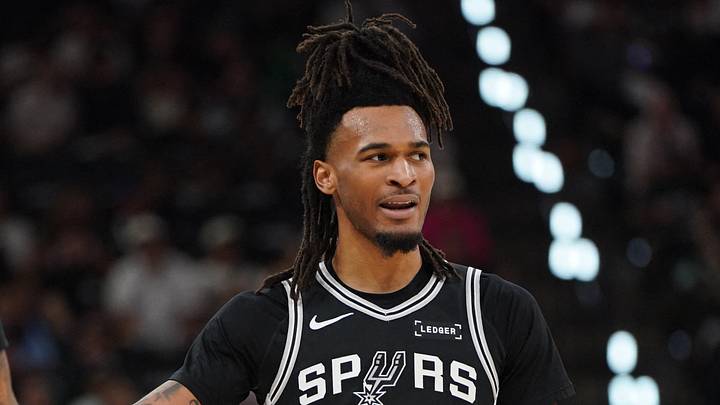
When the San Antonio Spurs assembled a high-velocity, multi-guard engine featuring veteran dynamo De’Aaron Fox, rising star Stephon Castle, and explosive youngster Dylan Harper, skeptics across the league were quick to sound the alarm. The buzzword of the summer was “logjam”—a perceived redundancy of ball-dominant talent that pundits argued would inevitably stunt growth and create structural friction in Gregg Popovich’s system.
Instead, following a grueling, high-stakes march to the Western Conference Finals, this trio didn’t just coexist. They weaponized their overlapping skill sets, turning a supposed roster bottleneck into one of the most lethal competitive advantages in modern basketball.
The Elite Geometry of Paint Pressure
The primary flaw in the preseason “logjam” critique was a fundamental misunderstanding of what makes elite playoff offenses tick. When the postseason spotlight ignites and the game hardens into a half-court chess match, transition opportunities evaporate, and perimeter-reliant offenses often flatline.
This is precisely where San Antonio’s guard rotation flips the script. During their deep playoff run, all three guards finished inside the top ten league-wide in fouls drawn on drives. That relentless, north-south pressure completely fractures opposing defensive schemes, forcing rotational defenders to make impossible split-second decisions on the interior.
- De’Aaron Fox’s Veteran Craft: Armed with nearly a decade of high-level experience, Fox leverages his blistering first step with subtle deceleration, using clever body angles to invite contact and draw cheap fouls from scrambling recovery defenders.
- Stephon Castle’s Snake Dribbles: The sophomore sensation has mastered the art of the “snake” dribble in the pick-and-roll, bending the defense to his will and manipulating big men on switches to live at the charity stripe.
- Dylan Harper’s Unflappable Poise: Defying his youth, Harper plays with the pacing of a ten-year veteran. His elite footwork—featuring sudden drop-steps, sophisticated pump-fakes, and an uncanny ability to stop on a dime—consistently gets primary markers caught chasing in mid-air.
A Championship Blueprint Moving Forward
As the Spurs look toward the rigors of the upcoming season, this backcourt trio provides an invaluable luxury: absolute insulation against scoring droughts. On nights when Victor Wembanyama commands heavy double-teams or perimeter jumpers fail to fall, San Antonio possesses three distinct initiators capable of putting their heads down, attacking downhill, and manufacturing points at the free-throw line.
Of course, unlocking their absolute ceiling requires fine-tuning. Improving their efficiency at the free-throw line—where each guard hovered in the 70% range last spring—will be the final frontier in converting high-volume foul-drawing into absolute dominance.
Ultimately, the narrative surrounding San Antonio’s backcourt has fundamentally shifted. What critics once dismissed as a crowded roster headache has evolved into a masterclass in modern roster construction, proving beyond a doubt that elite talent, when harnessed correctly, can never truly be locked in a jam.