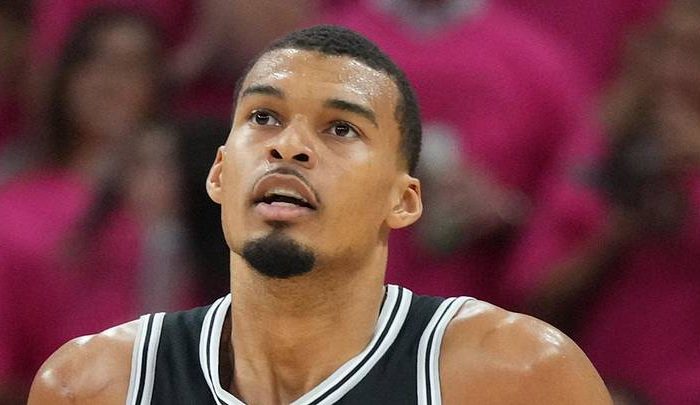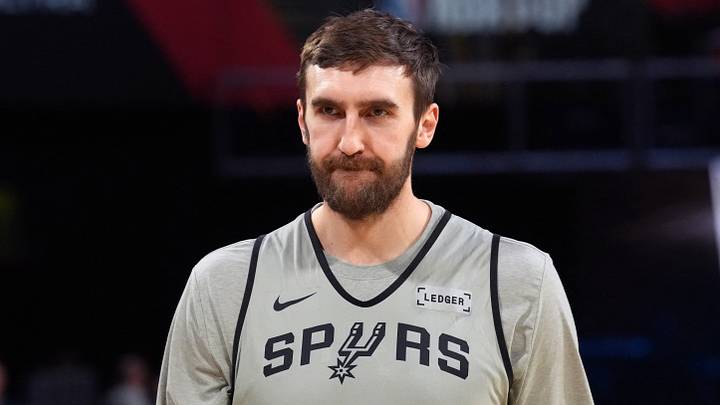
The San Antonio Spurs’ pursuit of frontcourt depth behind Victor Wembanyama may have solved itself much faster than front office executives anticipated, as rookie big man Tarris Reed Jr. is putting immense pressure on veteran center Luke Kornet.
Despite San Antonio falling 119-109 to the Utah Jazz in preseason action, Reed Jr. once again stole the spotlight with an explosive display of physical rebounding, hard screening, and rim protection.
His rapid adaptation to the NBA game—combined with Kornet’s recent struggles dating back to the 2026 postseason—has sparked growing speculation that the Spurs could soon look to move Kornet’s $10 million annual salary to avoid luxury tax headaches.
Kornet’s Postseason Struggles Open the Door for Rookie Dominance
Kornet was brought in to serve as a high-floor, reliable regular-season backup who could fill in as a spot-starter whenever Wembanyama required rest. While he executed that role during the 2025-26 regular season, his performance cratered during the playoffs.
Opposing postseason schemes actively targeted Kornet in pick-and-roll coverage, eroding his rim-protection effectiveness and forcing head coach Mitch Johnson to overwork Wembanyama during deep playoff runs.
That postseason collapse prompted San Antonio to draft both Jayden Quaintance (20th overall) and Tarris Reed Jr. (26th overall). While Quaintance remains sidelined without a clear timetable following knee surgery, Reed Jr. has stepped up as a battle-tested, instant-impact center capable of playing meaningful regular-season minutes right out of the gate.
The Second-Apron Threat: Why Kornet’s $10M Deal Makes Him Expendable
Beyond on-court performance, the NBA’s punishing collective bargaining agreement rules are driving San Antonio’s strategic timeline regarding Kornet’s future.
As the Spurs approach key extensions for their core young talent, remaining below the restrictive second apron is a top financial priority for general manager Brian Wright.
Paying a backup center roughly $10 million per season becomes an unsustainable luxury when a rookie on a cost-controlled contract can replicate—or exceed—that production. Moving Kornet’s contract in a trade would clear crucial cap space while granting Reed Jr. full-time backup duties behind Wembanyama.
Tarris Reed Jr. Following the Carter Bryant Playbook
Reed Jr.’s immediate preseason impact is drawing direct comparisons to Carter Bryant’s breakout rookie campaign last year, where unexpected physical readiness earned him an immediate spot in Johnson’s nightly rotation.
Originally projected to sit third on the center depth chart, Reed Jr. has forced the Spurs’ coaching staff to completely reconsider their rotational plans.
If his dominant rebounding and physical presence continue into the regular season, Luke Kornet may not only lose his rotation spot—he could be wearing a different uniform before the transfer deadline.