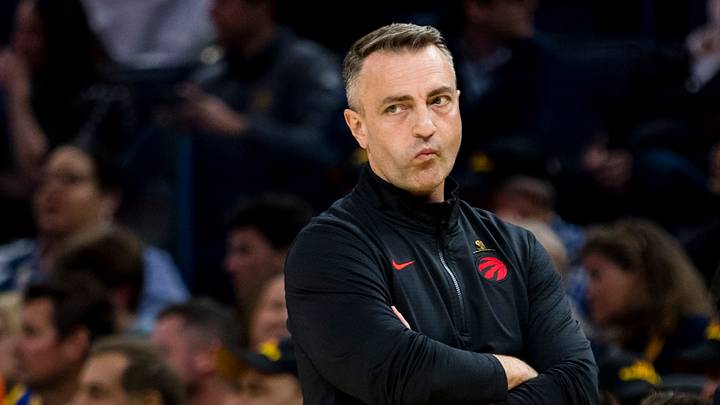
Head coach Darko Rajaković finally unveiled the Toronto Raptors’ full 10-man regular-season rotation in a thrilling 122–120 preseason clash against the New York Knicks, offering fans an eye-opening glimpse of both high-octane potential and glaring tactical flaws just days ahead of opening night.
Unlike their previous blowout encounter, New York fielded its full complement of starters at Madison Square Garden.
In a physical, playoff-like atmosphere, Toronto’s complete core took the floor together for the first time this fall.
While Scottie Barnes delivered an elite performance and bench sniper Jamison Battle provided instant offense, the narrow defeat exposed immediate growing pains—particularly surrounding perimeter shooting, turnover troubles, and scoring depth when superstar Kawhi Leonard has a quiet night.
Unveiling the 10-Man Core: The Starting Five and Second-Unit X-Factors
With opening night looming, Rajaković’s rotational framework is officially set.
The starting group anchored by Leonard, Barnes, Jakob Poeltl, Immanuel Quickley, and RJ Barrett was backed by a youthful, high-energy five-man bench unit featuring:
- Collin Murray-Boyles (CMB): Provided elite defensive versatility and physical interior presence.
- Jamison Battle: Proved his worth as Toronto’s primary floor spacer, knocking down clutch jumpers in his 2026 preseason debut.
- Ja’Kobe Walter & Jamal Shead: Brought relentless defensive intensity but struggled significantly to generate offensive output.
- Kyle Anderson: Operated as the veteran secondary facilitator for the second unit.
Perimeter Cold Spell: Three-Point Woes Threaten Offensive Flow
The primary concern haunting Toronto’s high-stakes rotation remains perimeter execution.
Against New York’s tight defensive shell, the Raptors’ glaring lack of consistent three-point creation resurfaced at the worst possible moment.
Star guards Quickley and Barrett struggled from distance, going a combined 3-of-11 from beyond the arc while stumbling into costly turnover trouble.
The cold spell extended to the bench guards, where Walter missed all three of his long-range attempts (0-for-3) and Shead converted just 1-of-4.
When 35-year-old Leonard is pacing himself or shaking off preseason rust, Toronto relies heavily on its young core to hit perimeter shots and clear driving lanes.
Instead, non-shooting stretches from the second unit allowed New York’s defense to collapse into the paint, stalling Toronto’s half-court offense.
Realistic Expectations for a Rising Contender
Transitioning from a developing lottery squad into a legitimate Eastern Conference playoff contender is rarely seamless.
While the offseason praise surrounding Leonard’s arrival and the growth of Barnes created massive hype, Thursday night served as a healthy reality check.
The Raptors possess the defensive foundation, length, and frontline talent to compete with the league’s elite.
However, as Rajaković tests his “next man up” philosophy throughout a grueling 82-game regular-season campaign, Toronto’s young guard depth must turn aggressive effort into tangible perimeter production if the Raptors intend to make noise in the East.