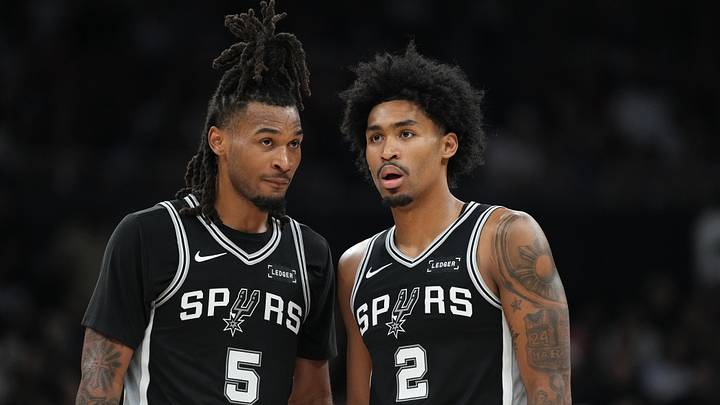
San Antonio Spurs head coach Gregg Popovich was handed a brutal reality check just days into the 2026-27 NBA season, as the team’s high-stakes starting lineup featuring a three-point-guard trio exposed a glaring tactical limitation: severely compromised floor spacing.
By deploying veteran De’Aaron Fox alongside rising star Stephon Castle and second-year talent Dylan Harper, the Spurs aimed to overwhelm opponents with elite playmaking, court vision, and relentless downhill dribble penetration.
However, early regular-season matchups against the Oklahoma City Thunder and Houston Rockets have proven that without consistent perimeter shooting around generational anchor Victor Wembanyama, San Antonio’s ambitious experiment could backfire disastrously.
High Volume, Cold Shooting: The Numbers Behind the Spacing Crisis
Through the opening week of the regular season, San Antonio’s offensive blueprint has relied heavily on firing away from deep—yet the accuracy simply hasn’t followed.
The statistical trend highlights a dangerous early-season imbalance:
- High-Volume Attempts: San Antonio ranks 11th in the NBA by launching a staggering 38.7 three-point attempts per game.
- Plummeting Efficiency: Despite the high volume, the Spurs rank 20th in three-point shooting percentage, falling drastically from their 15th-place finish during the 2025-26 campaign.
- Perimeter Brickfest: In their opening-night loss to the Thunder, San Antonio’s starting five combined to hit just six total three-pointers—with Castle surprisingly accounting for five of them.
Against the Houston Rockets, opposing defenders dared San Antonio to shoot over their low-block wall, allowing 37 perimeter attempts while daring Fox, Harper, and Wembanyama to prove they could make them pay.
The Rotation Dilemma: Benching Proven Sharpshooters
Part of the spacing bottleneck stems from Popovich’s updated rotational hierarchy.
To accommodate starting Fox, Castle, and Harper together, proven perimeter snipers have seen their minutes significantly reduced or eliminated:
- Julian Champagnie to the Bench: The wing’s reduced rotational role strips the starting unit of an elite, quick-trigger 3-and-D threat.
- Harrison Barnes Phase-Out: Veteran forward Harrison Barnes faces an impending exit from the active rotation once high-profile offseason acquisition Tobias Harris fully integrates into the secondary unit.
- Victor Wembanyama’s Slump: Wembanyama’s early-season perimeter accuracy has lagged far below his career averages, compounding the floor-spacing issue inside the paint.
The Path Forward: Can Castle and Harper Save the Experiment?
Despite early concerns, the Spurs possess reason for optimism.
Stephon Castle has shown remarkable development, knocking down 37.9% of his three-pointers on high-volume attempts from the top of the key.
Furthermore, Dylan Harper—who is currently connecting on just 28.6% from deep—shot a sizzling 48.6% from three over the final 30 games of his rookie season, suggesting a positive regression to the mean is imminent.
If Fox maintains his steady perimeter clip and Harper reclaims his shooting stroke, San Antonio’s triple-guard lineup has enough athletic slashing and transition playmaking to thrive.
Otherwise, Popovich may be forced to dismantle the three-guard experiment before the spacing crisis torpedoes the Spurs’ Western Conference playoff aspirations.