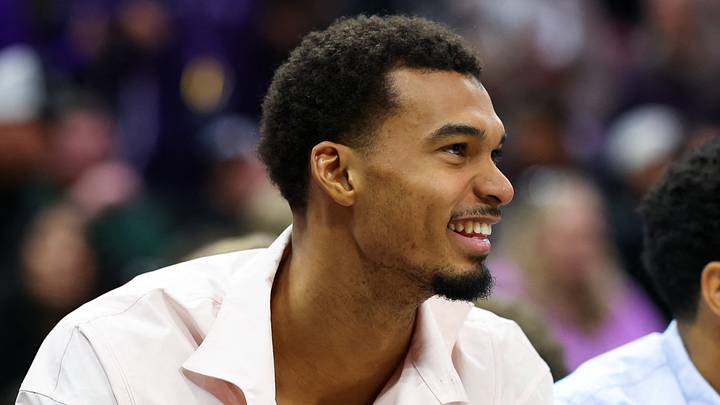
Victor Wembanyama has never appeared particularly interested in following the crowd. The San Antonio Spurs superstar has consistently shown a willingness to express his opinions, challenge questionable practices and explain the standards he believes professional basketball should uphold.
However, that attitude may not be winning him many friends around the NBA.
According to ESPN reporter Michael C. Wright, some players around the league have reportedly started describing Wembanyama as “Mr. Morality” and suggesting that he takes a moral high ground when discussing certain issues.
The comments emerged during a recent episode of The Hoop Collective, where Wright spoke with Brian Windhorst and Tim MacMahon about the Frenchman’s reputation among fellow players.
The apparent frustration comes shortly after Wembanyama made headlines with remarks about stat-padding following a remarkable 50-point performance. But the tension appears to extend beyond that particular comment.
What makes the situation interesting is that Wembanyama has repeatedly spoken about subjects that go beyond individual performances and basketball statistics. From the influence of gambling to the way the game should be played, he has demonstrated that he is comfortable expressing views that may not always be popular.
And perhaps that is precisely why some people find his comments uncomfortable.
Why Wembanyama’s outspoken personality is rubbing some players the wrong way
There is a difference between disagreeing with somebody and mocking them simply because they hold strong principles.
Wembanyama’s approach to basketball and life appears to be built around having standards and being prepared to defend them. He does not seem particularly concerned about whether every player agrees with his opinions.
Yet the reported “Mr. Morality” label raises an interesting question: why should having strong personal beliefs become a reason for ridicule?
People sometimes react negatively when somebody chooses a different path from the one they are accustomed to. Instead of examining the reasons behind that person’s decisions, they make jokes about the behaviour itself.
That does not automatically mean every criticism directed at Wembanyama is unfair. Players are entitled to disagree with him, question his arguments and offer alternative perspectives.
However, dismissing someone as self-righteous simply because they are willing to speak about their principles does not necessarily make their arguments any less valid.
In some situations, the discomfort may have less to do with the person speaking and more to do with the subjects they are bringing into the conversation.
Wembanyama’s comments about stat-padding were misunderstood
One of the recent controversies surrounding the Spurs star followed his 50-point performance.
After reaching that scoring milestone, Wembanyama was asked whether there was a morally right or wrong way to score 50 points, particularly when the discussion involved stat-padding.
His response quickly attracted attention.
“The greats, they don’t think about that,” Wembanyama said, referencing LeBron James, Shai Gilgeous-Alexander, Nikola Jokic and Luka Doncic as players he looks up to.
He explained that he did not believe those stars spent their time worrying about whether their scoring performances could be described as stat-padding. Instead, they concentrated on playing basketball and producing results.
Wembanyama’s wider point appeared to be that he wanted to approach scoring in the same way.
It is important to consider the full context rather than focusing only on the most provocative part of a statement. He specifically described those players as greats and presented them as examples he wanted to follow.
That makes it difficult to interpret his remarks as a direct attack on the established stars he mentioned.
Nevertheless, the conversation became another example of how quickly Wembanyama’s words can attract controversy.
His criticism of gambling in basketball is another major talking point
The stat-padding discussion is not the only reason Wembanyama has found himself at the centre of conversations about morality in the NBA.
Before the season, the Frenchman also expressed concerns about players becoming closely associated with gambling companies.
His position touches on an increasingly sensitive subject in professional basketball.
Sports betting has become much more visible in the NBA environment, with gambling partnerships and advertising appearing throughout the wider sports industry. At the same time, concerns about the relationship between betting and the integrity of competitions have continued to generate debate.
An anonymous player poll conducted by The Athletic earlier in the year reportedly found that more than 74 per cent of respondents did not believe the integrity of the game was in danger. However, some players still acknowledged that the league needed to address gambling-related concerns.
There are understandable reasons why this subject attracts attention.
Players and coaches have faced serious consequences in gambling-related investigations, while fans increasingly have opportunities to place bets on individual performances and specific in-game events.
That environment can create uncomfortable situations, particularly when athletes become targets of abuse from frustrated bettors who have lost money.
Wembanyama’s willingness to discuss these issues does not mean every concern he raises must automatically be accepted. But it does make the conversation worth having.
The same thing happened when he discussed ‘ethical basketball’
Another example came last season when Wembanyama spoke about what he described as “ethical basketball”.
Some interpreted his comments as criticism of the Oklahoma City Thunder and their style of play. The discussion quickly attracted attention, with supporters and critics debating whether he was questioning the way another team approached the game.
Wembanyama later clarified that his comments were not intended as an attack on Oklahoma City.
Still, the controversy demonstrated how easily his words can become part of a much bigger argument.
There is nothing unusual about players having strong opinions on basketball tactics. Teams, supporters and analysts regularly debate different styles of play, and the Thunder have also faced criticism over their approach.
Wembanyama should be entitled to express his views without every comment automatically becoming a personal dispute.
Perhaps the real issue is what his opinions represent
The reported reaction from some NBA players raises a bigger question about the culture surrounding the league.
If somebody believes that certain practices deserve more scrutiny, disagreeing with that person is perfectly reasonable. But turning their commitment to particular principles into a running joke does not address the substance of their argument.
It is possible that some players simply dislike Wembanyama’s directness or believe he sometimes expresses himself too strongly. That would be a legitimate difference of opinion.
It is also possible that his comments touch on subjects that some people would rather avoid examining.
There is no evidence that every player who disagrees with Wembanyama has something to hide, and it would be unfair to suggest otherwise. But his willingness to challenge uncomfortable issues should not automatically make him the problem.
At just 22, the Spurs superstar is already one of basketball’s most fascinating personalities. His talent is extraordinary, but his willingness to speak openly about the wider game is becoming another defining part of his public identity.
Whether other players agree with him or not, one thing is clear: Wembanyama should not have to abandon his principles simply to make himself more popular around the NBA.
Sometimes, the person asking uncomfortable questions is not the one who needs to look in the mirror.