The San Antonio Spurs have built one of the most promising young rosters in the NBA, but as the postseason approaches, one glaring flaw threatens to undermine their championship ambitions.
Despite a strong regular season and impressive overall balance, the Spurs’ three-point shooting remains the biggest question mark hanging over their title hopes.
Shooting inconsistency emerges as key concern
San Antonio finished the regular season firmly in the middle of the pack in perimeter efficiency and volume. While not disastrous, those numbers place them outside the profile of recent NBA champions, most of whom have ranked among the league’s elite three-point shooting teams.
That trend matters more in the playoffs, where half-court offense slows down and spacing becomes even more critical. Teams that struggle to punish defensive schemes from beyond the arc often find themselves locked into difficult, predictable scoring patterns.
Defensive game plans will target spacing weaknesses
The concern for the Spurs is not just statistical—it’s strategic. Opposing defenses are expected to collapse heavily on drives and dare San Antonio’s perimeter players to consistently hit open shots.
That puts added pressure on several key contributors who have yet to prove themselves as reliable long-range threats at playoff intensity.
Players like De’Aaron Fox, while explosive and elite in the midrange and at the rim, have historically been streaky from deep. Stephon Castle remains largely unproven as a consistent shooter, despite flashes of improvement. Young pieces such as Dylan Harper and Carter Bryant also fall into the category of developmental shooters who may be tested early.
Even Victor Wembanyama, though a unique offensive force, could face defensive schemes designed to force jump shots rather than interior dominance.
Offensive spacing could dictate playoff survival
The Spurs’ biggest issue is not individual talent, but lineup spacing. If multiple non-shooters share the floor in high-leverage playoff minutes, defenses will have the freedom to pack the paint and disrupt San Antonio’s offensive flow.
That scenario could force the Spurs into tougher, more contested possessions and limit the effectiveness of their transition game—one of their strongest weapons during the regular season.
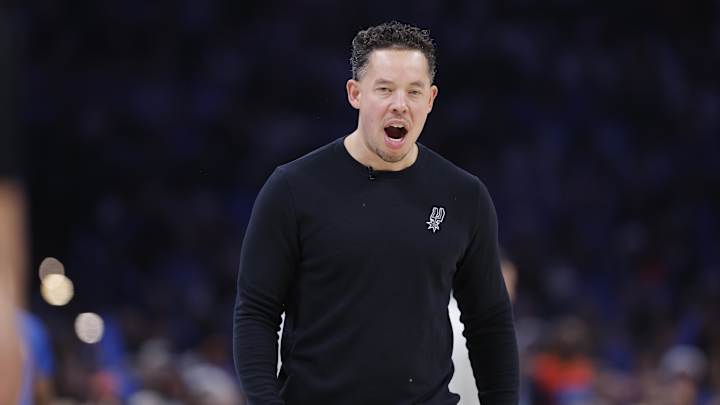
Head coach Mitch Johnson will face significant pressure to manage rotations carefully and ensure floor balance, particularly against elite defensive teams that are quick to exploit weaknesses.
Why the concern still has context
Despite the warning signs, the Spurs have already shown they can generate a high-level offense through creativity, pace, and star power. Their system does not rely purely on perimeter shooting to succeed.
However, history suggests that postseason success often depends on shot-making under pressure, especially from role players. Teams that cannot consistently convert open threes tend to struggle when defenses tighten and possessions slow down.
The final question heading into the playoffs
San Antonio’s ceiling remains undeniably high. Their talent, athleticism, and versatility make them a legitimate threat in any series.
But the margin for error in the postseason is small.
If the Spurs can’t resolve their shooting inconsistencies—or at least prove they can survive them against elite competition—this weakness could become the defining factor of their playoff run.
In a league where spacing is everything, one flaw may be enough to separate contenders from champions.