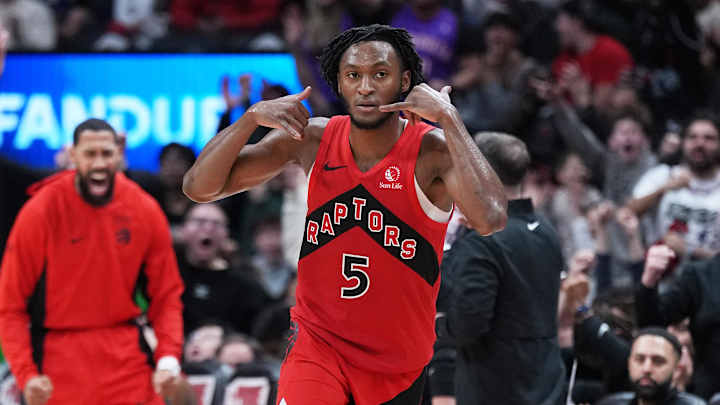
The playoff clash between the Toronto Raptors and Cleveland Cavaliers is shaping up to be a classic contrast in styles—Toronto’s pace-driven, defensive identity versus Cleveland’s structured, half-court offensive efficiency. But as the series approaches, one major uncertainty is threatening to tilt the balance before a single game is fully played: the health of .
Quickley’s status, currently listed as day-to-day with a hamstring issue, has quickly become one of the most important storylines in the matchup. And according to multiple NBA analysts, his availability could directly influence not just the Raptors’ rotation, but the entire tempo and identity of their playoff approach.
Raptors’ Identity Depends on Speed and Chaos
Toronto’s best basketball this season has come when they are able to push the pace, force turnovers, and turn defense into instant offense. Their game plan is simple in theory but difficult in execution: disrupt Cleveland’s rhythm, get out in transition, and avoid settling into half-court possessions.
That approach is especially important against a Cavaliers team built around controlled execution and elite backcourt scoring. Cleveland thrives when games slow down, allowing them to run structured sets and isolate mismatches.
If the Raptors can’t dictate tempo, the matchup becomes significantly more difficult.
Quickley’s Absence Would Change Everything
The concern surrounding Quickley is not just about scoring—it is about spacing, tempo control, and offensive balance.
Without him, Toronto loses one of its most reliable perimeter threats. His ability to stretch the floor forces defenders to stay honest, preventing opponents from collapsing into the paint. That spacing is what opens driving lanes for players like Scottie Barnes and RJ Barrett.
Analysts have pointed out that even if Toronto can still run in transition without him, replacing his shooting and offensive gravity is far more complicated.
In his absence, the Raptors may lean more heavily on bench playmakers such as Jamal Shead, who brings defensive intensity and passing ability but lacks consistent three-point shooting. Meanwhile, young shooters like Ja’Kobe Walter could see increased responsibility, though playoff pressure will test their consistency.
Cleveland’s Defensive Advantage Grows Without Him
The Cavaliers’ defensive strategy would also benefit significantly if Quickley is limited or unavailable. Without a proven perimeter shooter to respect, Cleveland can tighten its coverage in the paint, making it harder for Toronto’s slashers to attack the rim.
This is particularly important against Toronto’s physical offensive core, where players like Barnes rely on space to generate downhill momentum. If defenders can pack the paint without fear of being punished from deep, the Raptors’ offense risks becoming predictable.
Cleveland’s ability to dictate matchups in the half-court would increase dramatically under those conditions.
A Game-Time Decision That Shapes the Series
As things stand, Quickley remains questionable, and there is growing belief that even if he plays, his minutes and effectiveness could be limited. Hamstring injuries are notoriously difficult to manage, especially in high-intensity playoff environments where repeated bursts of speed are required.
The Raptors will likely delay a final decision as long as possible, hoping for late improvement. However, the uncertainty alone forces adjustments from both teams in preparation.
Bigger Than One Player
While Quickley’s status is central, this series is ultimately about two contrasting philosophies.
Toronto wants chaos—speed, disruption, and transition scoring. Cleveland wants control—structure, efficiency, and execution in the half-court. Whichever style dominates will likely dictate the outcome.
But in tightly matched playoff series, small edges matter. And right now, the biggest edge may come down to whether Toronto can rely on one of its most important backcourt pieces.
If Quickley plays and is effective, the Raptors’ identity remains intact. If not, the Cavaliers may gain exactly what they need: control of the game’s rhythm.
And in a series this evenly poised, that could be the difference between survival and elimination.