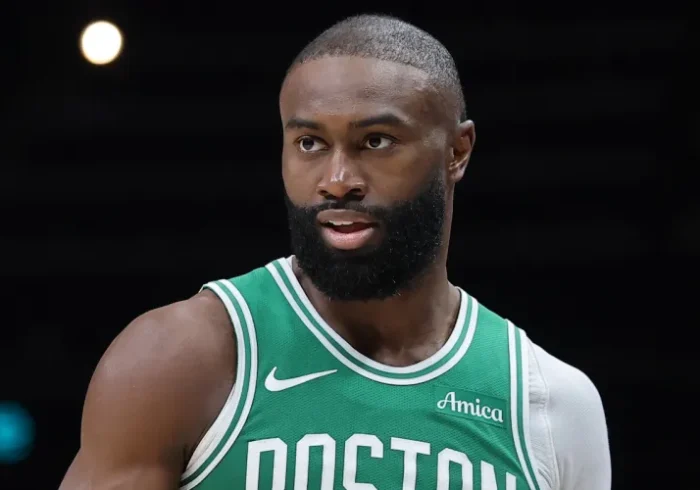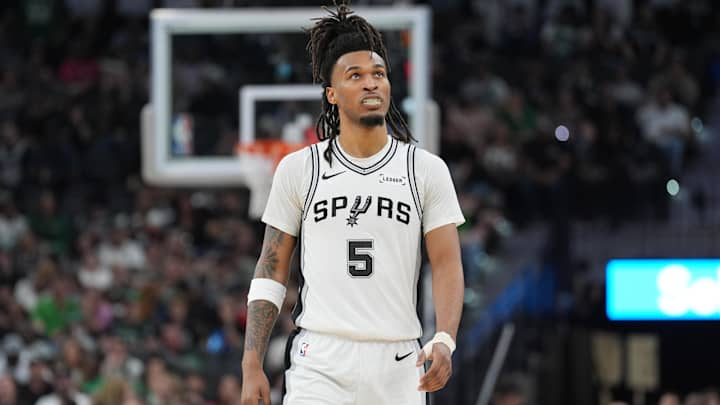
San Antonio Spurs guard Stephon Castle has seen his growing All-NBA case take a significant hit following a controversial league ruling on player eligibility.
Just as Castle’s impressive second-half surge had begun to generate serious recognition, the NBA confirmed that both Cade Cunningham and Luka Dončić would remain eligible for end-of-season awards—decisions that could ultimately push Castle out of contention.
A rising case built on consistency and growth
Castle has quietly been one of the Spurs’ standout performers this season, emerging as arguably their second-most impactful player behind Victor Wembanyama.
While he missed out on an All-Star selection, that alone didn’t eliminate his All-NBA chances. In fact, recent history has shown that players can still earn All-NBA honors without midseason recognition—Wembanyama himself achieved that as a rookie.
Castle’s late-season form has been particularly compelling. Since February, he has elevated his game significantly, averaging:
- 16.8 points
- 5.8 rebounds
- 7.9 assists
- Over 40% shooting from three-point range
Those numbers, combined with his all-around influence, had placed him firmly in the conversation—especially in a season where several stars risked missing eligibility thresholds.
The ruling that changed everything
Castle’s hopes, however, were heavily dependent on a specific scenario.
With the NBA’s 65-game minimum rule for award eligibility, there was a realistic chance that high-profile players like Cunningham and Dončić could be ruled out. That would have opened up space for emerging talents like Castle to break into the All-NBA teams.
Instead, the league granted both players eligibility under “extraordinary circumstances,” despite injuries and, in Dončić’s case, suspension-related absences.
The decision has drawn scrutiny, particularly as similar appeals—such as one involving Anthony Edwards—were not upheld.
A shrinking path to recognition
With Cunningham and Dončić now firmly back in the mix, the competition for All-NBA spots becomes significantly tougher.
Castle’s statistical output, while impressive, still sits just below the elite tier typically required for selection. Without those eligibility openings, his chances now rely heavily on voters taking context into account—such as his late-season form and overall impact.
There remains a slim possibility that voters penalise players who missed substantial time, even if technically eligible. But realistically, Castle’s path has narrowed considerably.
Looking ahead: playoffs and future potential
While this setback is frustrating, it does not diminish what has been a breakthrough campaign for Castle.
The Spurs still have plenty to play for, and a strong postseason showing could further elevate his reputation across the league. More importantly, his trajectory suggests that All-NBA recognition may simply be a matter of timing rather than ability.
At his current rate of development, Castle looks poised to become a regular contender for top honours in the seasons ahead.
Final word
Stephon Castle did everything right—improved, performed, and delivered when it mattered most.
But in a league where fine margins and technical rulings can shape narratives, his All-NBA hopes may have been undone by factors beyond his control.
For now, the spotlight shifts to what comes next—and whether he can turn this disappointment into motivation for an even bigger leap forward.