The Oklahoma City Thunder are navigating one of their first real postseason roster disruptions, and the early results are already reshaping how the team distributes responsibility on offense.
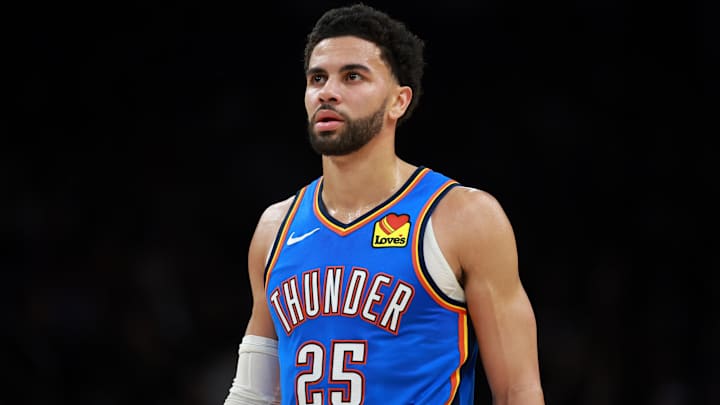
With Jalen Williams sidelined due to a hamstring strain, Oklahoma City has turned to second-year guard Ajay Mitchell to fill a significantly larger role in the starting lineup. While Mitchell’s emergence has been building throughout the season, the playoffs are providing his first true test under heightened stakes—and so far, he has responded with noticeable confidence.
Mitchell’s Game 3 performance against the Phoenix Suns underscored just how quickly his role has expanded. He finished with 20 shot attempts, even surpassing franchise cornerstone Shai Gilgeous-Alexander in field goal volume during the contest. That level of offensive involvement signals a growing trust from the coaching staff, as well as an evolving pecking order within the Thunder’s rotation while Williams remains unavailable.
What makes Mitchell’s surge even more intriguing is that it hasn’t come out of nowhere. During the regular season, he steadily carved out a meaningful role, appearing in 16 starts and averaging solid production across the board—nearly 15 points per game along with efficient shooting splits from both the field and beyond the arc. His blend of scoring confidence, defensive activity, and composure has made him one of the more quietly impactful developmental wins on the roster.
Now, however, the expectations are entirely different. Playoff basketball demands more creation, more shot responsibility, and more adaptability—especially when a core contributor like Williams is missing. Mitchell’s willingness to step into that gap has been one of the early positives for Oklahoma City in this series.
Not all adjustments have been seamless, though. While Mitchell’s increased aggression has been welcomed, the Thunder have also seen inconsistency elsewhere in the lineup, particularly from Chet Holmgren. In Game 3, Holmgren finished with just 10 points on six shot attempts, a noticeably low level of offensive involvement for a player widely viewed as the team’s second scoring option behind Gilgeous-Alexander.
Despite playing 29 minutes, Holmgren ranked fourth on the team in scoring and near the bottom in shot volume, a concerning trend given his regular-season averages of over 17 points per game on double-digit attempts. His quiet offensive night stood in contrast to Mitchell’s assertiveness, highlighting a shifting dynamic in how Oklahoma City is generating offense without Williams.
Even so, the Thunder’s ability to win convincingly despite uneven scoring contributions reinforces the broader identity of the team. Their depth, defensive discipline, and star power at the top allow them to withstand fluctuations in secondary production—at least in the short term.
Still, the bigger question going forward is whether this balance can hold in more challenging postseason environments. Mitchell’s rise suggests Oklahoma City may have uncovered another reliable creator, but it also raises questions about consistency among their established frontcourt pieces.
As the series progresses, the Thunder will likely continue leaning into Mitchell’s growing confidence while simultaneously searching for more assertiveness from Holmgren and the rest of the supporting cast. How those adjustments play out could shape not just this series, but the team’s broader playoff trajectory.