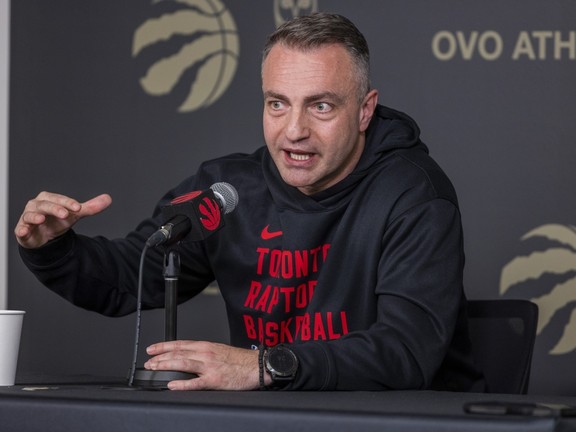
The Toronto Raptors may have finished their season on a positive note, but head coach Darko Rajaković is already operating several steps ahead of everyone else in the organization.
While fans are still processing a campaign that ended with a Game 7 loss in Cleveland, the Raptors’ bench boss is deep into offseason planning mode — and not just casually.
He’s mapping out the future in detail.
Rajaković already thinking months ahead
Rajaković revealed that he has already prepared a significant portion of his first-team meeting for next season, admitting that planning for the summer began “two, three months ago.”
That level of preparation reflects how he approaches his role: constant evaluation, constant adjustment, no downtime when it comes to team development.
Even during the brief offseason window, his focus won’t fully shift away from basketball. Instead, he plans to work with his mental performance coach to improve his leadership approach and refine how he guides the group forward.
The message is clear — Toronto isn’t treating this season as an endpoint, but as a stepping stone.
Scottie Barnes becomes the undeniable centerpiece
If there is one player the Raptors are building around without hesitation, it’s Scottie Barnes.
Rajaković didn’t just praise Barnes — he framed him as one of the most versatile and impactful young stars in the league, capable of doing everything from initiating offense to anchoring defense.
But the coaching staff also sees room for something even bigger.
Barnes’ next leap, according to Rajaković, comes down to refinement: sharper finishing, stronger ball-handling, and continued development as a shooter. The physical tools are already elite — the goal now is unlocking consistency at a superstar level.
And internally, there’s confidence he can sustain that production over a full season, not just flashes in big moments.
The Ingram balance question looms large
Brandon Ingram’s role remains one of the most intriguing tactical puzzles for the Raptors.
On one hand, he was the team’s primary scoring option and often the reason Toronto stayed competitive in difficult stretches. On the other, the Raptors played their best basketball when the ball moved faster and more freely — a style that doesn’t naturally align with Ingram’s slower, isolation-heavy tendencies.
Rajaković believes the solution is evolution, not replacement.
He wants Ingram involved earlier in possessions, pushing in transition, and becoming more of a playmaker rather than just a scorer. The idea is to expand his influence without sacrificing the team’s pace and identity.
It’s a delicate balance — but one the Raptors are committed to exploring rather than abandoning.
The supporting cast gets clear direction
Beyond the stars, Rajaković laid out direct developmental goals for several young and rotational players.
The focus areas are blunt and specific:
- Strength and finishing inside for Ja’Kobe Walter
- Interior scoring growth for Jamal Shead
- Defensive and shooting improvement for Gradey Dick
- Physical development and role flexibility for Sandro Mamukelashvili
- Continued growth in versatility for Collin Murray-Boyles, who already earned trust as a rookie
Nothing is vague here. Every player has a defined growth path heading into the offseason.
A season that ended, but didn’t finish the process
Even after a disappointing playoff exit, Rajaković’s tone suggests something important: the Raptors are not reacting emotionally to the outcome.
Instead, they’re treating the entire season as data.
There’s pride in the progress — more competitiveness, clearer identity, stronger individual development — but also recognition that the gap between “good” and “great” still exists.
Toronto didn’t just finish a season.
They started building the next version of themselves.