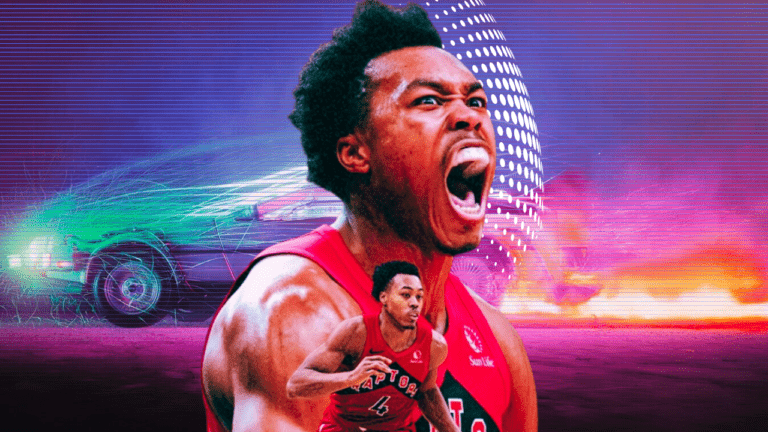
For years, Scottie Barnes has been one of the hardest-working players on the Toronto Raptors roster. His impact is not limited to scoring or creating plays. The All-Star constantly covers ground, battles on defence and takes on difficult assignments that demand an enormous amount of energy.
That makes one question particularly important heading into the 2026-27 season: can Toronto find a way to make Barnes’ offensive life easier without taking away what makes him so valuable defensively?
The answer could lie in transition.
Barnes has already demonstrated that he can influence games on both ends of the floor. During last season’s playoff series against Cleveland, he produced 24 points, nine rebounds and six assists per game, showing once again how much responsibility he can handle.
But maintaining that defensive intensity while carrying a major offensive workload is a difficult balancing act.
One of the biggest challenges for Barnes has been deciding where his energy is best spent. He remains deeply committed to defence, but that commitment can sometimes come at the expense of his offensive production.
There are relatively straightforward ways for a player in Barnes’ position to score efficiently: knock down open catch-and-shoot threes, receive the ball close to the basket or attack before the opposing defence is fully organised.
The first option depends heavily on Barnes improving his outside shooting.
His 38 percent three-point shooting during the seven-game Cleveland series offered some encouragement, but Toronto would obviously benefit enormously if that level of shooting became sustainable over an entire season.
The second option is more complicated.
Barnes can finish around the basket, but he spends too much time handling the ball to become a full-time cutter or roller. Jakob Poeltl is also a natural fit for that role and remains one of Toronto’s most effective screeners and roll men.
That leaves transition as perhaps the most intriguing opportunity.
Barnes has the size, speed and strength to become extremely difficult to stop when he gets a running start. Rather than asking him to repeatedly create against a set defence, Toronto could allow him to attack while opponents are still trying to get organised.
We have already seen glimpses of this.
Early last season, Toronto used Barnes more frequently as an outlet option. Instead of immediately giving him the ball and asking him to navigate a crowded floor, the Raptors could send him racing upcourt, where his physical advantages became much more difficult for defenders to handle.
The strategy worked.
Barnes emerged as one of the NBA’s more dangerous transition scorers.
Then Toronto encountered another problem.
The Raptors struggled badly on the defensive glass, forcing Barnes to devote more attention to rebounding and helping stabilise the defence. As his defensive responsibilities increased, his opportunities to sprint into attacking space naturally declined.
That is where Kawhi Leonard could become particularly important.
Leonard’s presence gives Toronto another player capable of controlling possessions without sacrificing efficiency. He has historically been an outstanding defensive rebounder from the wing and remains a highly effective transition player.
That could allow Barnes to get out earlier.
Instead of Barnes having to remain around the basket to secure every defensive rebound, Leonard can potentially handle more of that responsibility and give Barnes permission to start running immediately.
There is another benefit.
Leonard’s shooting threat can force defenders to stay attached to him. That creates additional space for Barnes to attack the rim, whether he receives an outlet pass or grabs the rebound himself.
The Raptors could therefore create a chain reaction: Leonard’s shooting pulls defenders away, Barnes gets into space earlier and Toronto turns defence into offence before opponents have time to establish their half-court defence.
It is still only a projection, and there is no guarantee the plan will work perfectly.
But the potential is obvious.
Toronto does not necessarily need Barnes to become a completely different offensive player. The more interesting possibility is finding ways to maximise the abilities he already possesses while reducing the amount of energy he has to spend creating difficult shots.
If the Raptors can improve their defensive rebounding, surround Barnes with enough shooting and use Leonard’s presence intelligently, the conditions could finally be right for Barnes to attack open court at full speed.
And if that happens consistently, Toronto may discover that one of its most dangerous offensive weapons has been sitting in plain sight all along.
The real question now is simple: will the Raptors finally give Scottie Barnes the green light to run?