When the Toronto Raptors welcomed Kawhi Leonard back for a sensational second stint in franchise history, front office executives went into the agreement fully aware of the inherent risks. Leonard is unquestionably one of the greatest and most lethal playoff performers in NBA history, but his storied career has been inextricably dogged by an unforgiving injury history.
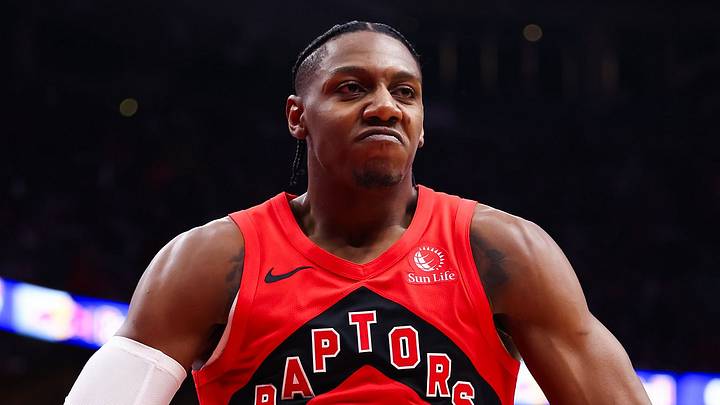
With Leonard’s game-to-game availability acting as a perennial question mark for Toronto, the franchise’s ultimate blueprint for success may depend on an unexpected cornerstone: polarizing shooting guard RJ Barrett.
While critics often home in on Barrett’s shooting efficiency, the Canadian wing has quietly evolved into one of the most dynamic shot creators and secondary playmakers at his position. More importantly, when Leonard inevitably requires load management or extended recovery time during the 82-game grind, Barrett is uniquely positioned to shoulder the offensive burden.
The Reality of Leonard’s Injury History
Building a championship contender around Leonard requires embracing a strict risk-management strategy. Over the last nine seasons, Leonard has missed at least 20 games in six of them. Though he managed 65 appearances in 2025-26 and 68 in 2023-24, those relatively healthy stretches were sandwiched around missing 45 games in 2024-25 and sitting out the entire 2021-22 campaign.
With Brandon Ingram having departed for the Los Angeles Clippers in the blockbuster trade that brought Leonard back to the Sixside, the Raptors’ scoring depth took a hit. That leaves Barrett stepping up as the team’s leading returning scorer, coming off a campaign where he averaged 19.3 points in 30.3 minutes per night—translating to a prolific 22.9 points per 36 minutes, a benchmark he has met or exceeded for three consecutive seasons.
Shining When the Lights Are Bright
While regular-season efficiency debates will always follow high-volume scorers, Barrett emphatically silenced his doubters during the 2026 postseason.
Going toe-to-toe with elite postseason operators like James Harden and Donovan Mitchell in a gruelling playoff run, Barrett put up stellar averages:
- Points: 24.1 per game
- Rebounds: 7.0 per game
- Assists: 4.0 per game
- Shooting Splits: .477 / .386 / .634 (including 2.4 made three-pointers per contest)
By tying with Scottie Barnes for the team scoring lead during that postseason stretch, Barrett proved he possesses the mental fortitude and physical resilience to rise to the occasion when the stakes reach their peak.
Protecting Scottie Barnes’ Workload
Some analysts might wonder why franchise cornerstone Scottie Barnes shouldn’t simply fill the scoring void if Leonard misses time. However, leaning too heavily on Barnes to match Leonard’s scoring output while simultaneously asking him to lock down opponents’ best players, facilitate the offense, and anchor the team’s defensive schemes risks burning out the franchise’s multi-faceted engine.
By relying on Barrett as a proven high-volume scorer to soak up the touches, Toronto can preserve Barnes’ energy for his do-it-all role and give Leonard the flexible schedule he needs to stay healthy.
Barrett may be an imperfect answer, but in the chess match of navigating an NBA season, he is the Raptors’ best bet to keep the ship sailing smoothly.
Do you think RJ Barrett can sustain his playoff scoring numbers across a full 82-game regular season if Kawhi Leonard misses extended time?