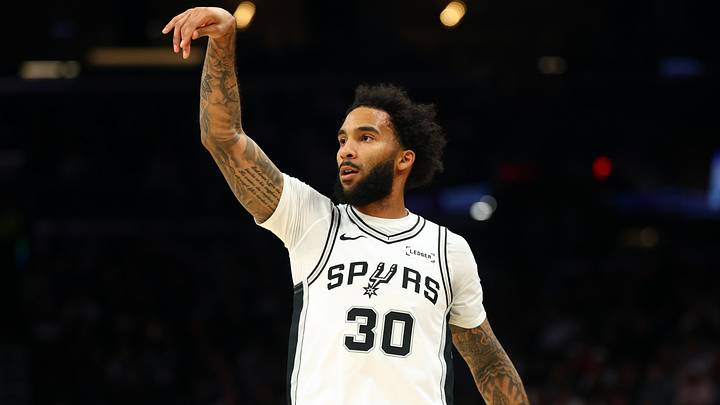
The San Antonio Spurs may have uncovered one of their most valuable players in an unlikely place, and Julian Champagnie is increasingly proving that he deserves recognition for more than simply being compared to a former franchise favourite.
Champagnie is back in the starting lineup, and his recent performances have provided another reminder of how important he has become to San Antonio. Once an overlooked player who struggled to establish himself elsewhere, he has gradually developed into a reliable contributor with an offensive skill set that continues to expand.
For a while, comparisons with Danny Green seemed understandable. Both players arrived in San Antonio without enormous expectations, both experienced setbacks with other teams, and both built reputations around their ability to make three-point shots.
However, Champagnie’s development has reached a point where those comparisons no longer tell the full story.
Green enjoyed an excellent career with the Spurs, spending nine years with the organisation and becoming an important part of its success. But while the two players share some similarities, their differences are becoming increasingly difficult to ignore.
Champagnie is developing into a more versatile offensive player, and that could make him an especially valuable piece of the Spurs’ future.
Champagnie has moved beyond the Danny Green comparison
Green was known for his defensive intensity and perimeter shooting. At his best, he was an outstanding three-and-D player who could make life difficult for opposing guards while providing an important scoring threat from beyond the arc.
Champagnie has some similarities, particularly when it comes to his shooting.
However, there are noticeable differences in how the two players contribute offensively.
Green could be extremely streaky from three-point range. There were stretches when he struggled to find his rhythm before suddenly producing several games of exceptional shooting.
Champagnie can also experience shooting fluctuations, but he has demonstrated a greater ability to contribute when his perimeter shots are not falling.
His offensive game is not built entirely around standing outside and waiting for an opportunity to shoot.
He can attack defenders who close out aggressively, put the ball on the floor and drive towards the basket. Although he is not an elite ball-handler, that additional ability gives San Antonio another way to create scoring opportunities.
It is an important distinction because opponents cannot defend him in exactly the same way they might defend a traditional perimeter specialist.
His three-point shooting is still a major weapon
None of this means Champagnie has lost the ability that initially made him valuable.
If anything, his shooting remains one of the most impressive parts of his game.
One of the standout moments of his Spurs career came when he exploded for 11 three-pointers against the New York Knicks on New Year’s Eve.
That performance demonstrated just how dangerous he can become when he finds his rhythm.
It was not an isolated display, either. Champagnie has recorded at least six made three-pointers in seven games during his Spurs career, including twice already this season.
His ability to produce those scoring explosions gives San Antonio an important offensive weapon, particularly when opposing defences concentrate their attention on the team’s biggest stars.
The difference is that Champagnie now offers more than just perimeter shooting.
He can punish defenders who give him space, attack closeouts and contribute around the basket. That additional versatility makes him a more difficult matchup and gives the Spurs greater flexibility offensively.
The numbers highlight his offensive advantage
Champagnie’s statistical profile provides further evidence of how much his game has developed.
During the previous season, he averaged 8.4 field-goal attempts per game, with 2.0 of those attempts coming from within 14 feet of the basket.
Those opportunities included layups, dunks, putbacks, floaters and mid-range attempts.
His ability to score from different areas helped him convert 59.9 per cent of his two-point attempts.
For comparison, Green averaged 45.3 per cent on two-point field goals during his time with San Antonio.
Champagnie is also currently shooting 41.7 per cent from three-point range while attempting them at a higher volume than Green ever managed during his Spurs career.
Another statistic reinforces the difference between the two offensively.
Champagnie’s current true shooting percentage stands at 59.2 per cent, compared with Green’s 55.9 per cent during his San Antonio spell.
These numbers do not erase Green’s contributions or suggest that Champagnie is already the more accomplished overall player. They do, however, highlight how effective Champagnie has become as an offensive option.
Green still has one important advantage
There is one area where the comparison remains firmly in Green’s favour: defence.
Green was an exceptional defender during his time in San Antonio, and his ability to guard opposing players was a major reason he became such an important part of the team.
Champagnie is not a poor defender, but he has not reached the same level.
That difference should not be overlooked when assessing their overall careers.
Nevertheless, Champagnie’s other qualities make him an attractive player for the Spurs. Standing at 6-foot-8, he brings valuable size to the wing position and has also shown that he can contribute on the boards.
His combination of shooting, offensive versatility and rebounding gives San Antonio a player who can help in several different ways without requiring the ball on every possession.
For a team looking to build a competitive roster around its young talent, those contributions are extremely valuable.
San Antonio may have discovered another development success story
Perhaps the most encouraging aspect of Champagnie’s rise is how the Spurs managed to uncover his potential.
He was not considered an obvious future star when he arrived in the NBA. Like Green before him, he had to overcome setbacks and prove that he belonged at the highest level.
San Antonio’s ability to identify his potential and help him develop into a productive rotation player deserves considerable credit.
Champagnie has now established himself as more than an interesting shooting option. His growing offensive confidence and ability to contribute in different situations have made him an increasingly important part of the team’s plans.
The Danny Green comparisons will probably continue because their journeys share some similarities. But Champagnie is building an identity of his own, and his offensive development is the biggest reason why.
There is still plenty of work ahead, particularly if he wants to become a more complete defensive player.
However, the Spurs have every reason to be encouraged by what they are seeing.
Green helped San Antonio win a championship, and Champagnie will hope to make a similar contribution to the next successful era of the franchise.
For now, though, he deserves to be recognised for what he is becoming rather than constantly being measured against somebody else’s career.