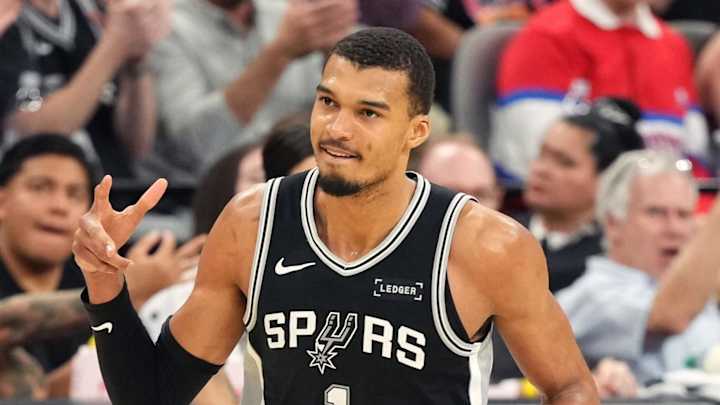
Victor Wembanyama is rapidly becoming the center of one of the NBA’s most intriguing long-term storylines, and the league may be underestimating just how quickly things could shift once he is fully back in action. The San Antonio Spurs’ recent stretch without their star has unintentionally highlighted both their vulnerability and their surprising resilience, setting the stage for what could become a dramatic leap forward once he returns.
Even without official confirmation of his availability for the next game, expectations remain that Wembanyama could rejoin the lineup soon. His presence around the team during his recovery has only fueled optimism. But the real focus isn’t simply on whether he plays again—it’s on how his return could transform both his game and the Spurs’ overall identity.
At just the early stage of his career, Wembanyama already stands out for his extraordinary ability to process the game at an elite level. His combination of size, skill, and basketball intelligence allows him to adapt faster than most young players. However, the playoffs introduce a different kind of challenge. Defensive schemes tighten, double teams arrive faster, and opponents deploy more creative physical and tactical pressure designed specifically to disrupt dominant stars.
Those conditions, while difficult, could actually accelerate his growth. Each adjustment opponents make forces him to respond in real time, effectively turning every possession into a learning experience. Over time, that kind of exposure can sharpen his decision-making and expand his offensive toolkit in ways that regular-season play often cannot.
What makes the situation even more concerning for opposing teams is the development of San Antonio’s supporting cast during his absence. The Spurs’ younger players have gained valuable postseason experience and shown they can compete under pressure. That growth matters because it means defenses can no longer focus solely on containing their superstar when he returns.
If the team reintegrates Wembanyama into a group that has already built confidence in high-stakes moments, the Spurs become significantly more difficult to scheme against. Opponents will face a dilemma: commit extra attention to him and risk exposure elsewhere, or play more balanced defense and allow him to dominate individually.
The broader concern around the league is not just his immediate impact, but his trajectory. Each challenge he faces seems to produce a faster-than-expected adjustment. As defenses try new methods—more physical play, quicker doubles, or crowding the paint—he continues to evolve in response. That cycle of adaptation is what makes his development so dangerous for the rest of the NBA.
Ultimately, the idea forming around San Antonio is simple but unsettling for competitors: a rapidly improving superstar learning from playoff-level pressure, combined with a young roster growing more confident at the same time. If that combination continues to progress, the Spurs could shift from a developing team into a legitimate powerhouse sooner than many expect.
In that sense, the league may not just be watching the return of a rising star—it may be witnessing the early stages of a team learning how to become dominant together.