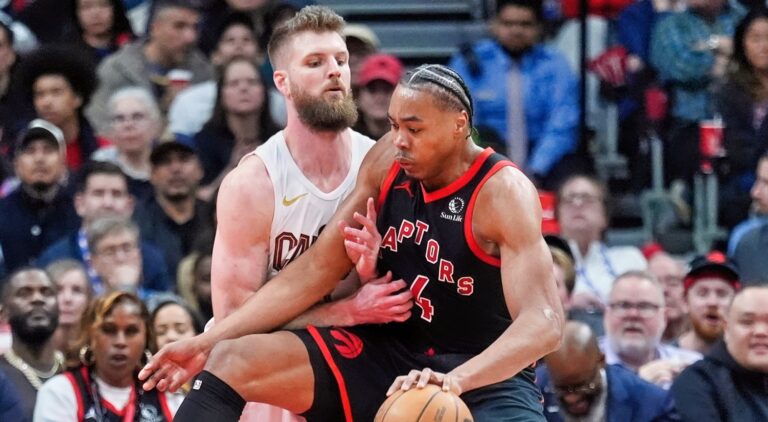
The Toronto Raptors’ grueling postseason journey may have been brutally cut short by the Cleveland Cavaliers in a heartbreaking seven-game first-round exit, but the drama surrounding their franchise cornerstone is only just beginning.
Furious controversies erupted across social media late Friday night after the NBA officially unveiled its 2025-26 All-Defensive rosters. Despite orchestrating an absolutely historic, unprecedented defensive campaign, Raptors forward Scottie Barnes found himself stunningly relegated to the All-Defensive Second Team—prompting an immediate, expletive-laced public call-out from the young superstar.
The Social Media Meltdown
Minutes after the voting ballots were published, the 24-year-old two-time NBA All-Star took directly to X (formerly Twitter) to vent his profound disbelief and raw frustration regarding the voting panel’s verdict.
“Mannnn what do I tell ya, Bulls*** Let’s keep working,” Barnes posted, pulling no punches about the perceived disrespect.
While league officials routinely discourage public criticism of awards voting, Barnes’ outrage is backed by an incredibly ironclad statistical case that has left analysts and Raptors fans completely baffled.
The DPOY Paradox: White vs. Barnes
The core of the controversy lies in a glaring, illogical discrepancy between the Defensive Player of the Year (DPOY) voting layout and the final All-Defensive First Team roster construction.
Barnes finished an elite fifth overall in the global Defensive Player of the Year voting. Yet, Boston Celtics guard Derrick White—who finished firmly behind Barnes in the overall DPOY standings—somehow leaped ahead of the Florida native to snatch the final, coveted First Team slot.
The final voting margins illustrate a razor-thin, agonizingly close finish. Barnes accumulated 130 total voting points, falling a mere 16 points short of White’s 146 points.
A Historic “Stocks” Showcase
Statistically, Barnes operated as the premier, elite structural anchor for Toronto’s defensive schemes all season. He rounded out the campaign averaging an outstanding 1.5 blocks and 1.4 steals per game, while simultaneously bearing the heavy offensive burden of putting up 18.1 points, 7.5 rebounds, and 5.9 assists.
According to data compiled by StatMuse, Barnes’ historic defensive output featured several mind-blowing milestones:
- The 100-100 Club: He became the first NBA player in the entire 2020s decade to register at least 100 blocks and 100 steals in a single, individual season.
- The Steals/Blocks Hierarchy: He finished the year ranked 9th overall in total league steals and 6th in total blocks.
- Eastern Dominance: Barnes officially led the entire Eastern Conference in total combined “stocks” (steals + blocks).
The Overload Dilemma: Moving Forward in Toronto
While the awards snub leaves a bitter taste, the silver lining remains Barnes’ astronomical developmental trajectory. With Immanuel Quickley sidelined by a severe hamstring injury and Brandon Ingram struggling underperforming before being fully shut down, Barnes carried Toronto on his back in the postseason.
Against the Cavaliers, Barnes morphed into a terrifying Jokic-esque hybrid, averaging an elite 24.1 points, 6.1 rebounds, and 8.6 assists to drag a heavily depleted roster to a Game 7.
However, league executives note that this grueling stretch exposed a dangerous structural vulnerability. Expecting Barnes to act as the primary scorer, chief playmaker, and switchable multi-positional defensive stopper is completely unsustainable over an 82-game calendar. If the front office expects to build a legitimate contender around their defensive anchor, bringing in elite structural reinforcements this summer is no longer optional—it is mandatory.