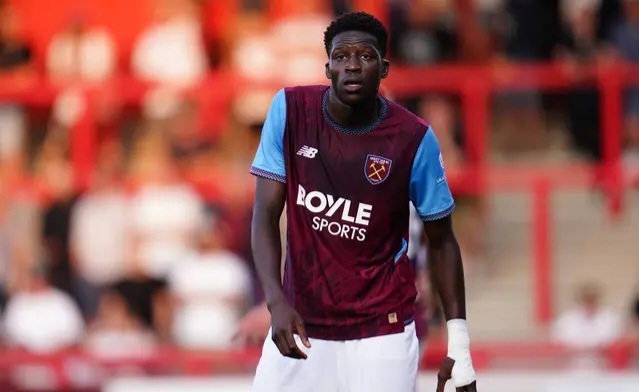
West Ham United ultimately secured another vital Championship victory on their travels, returning from Lancashire with three points after putting three goals past Bolton Wanderers. Jarrod Bowen stole the show with a clinical brace, and on the surface, the attacking output appeared to be firing on all cylinders.
However, a closer look at Nuno Espirito Santo’s tactical setup reveals that one of his most intriguing midfield experiments didn’t quite deliver the intended results.
During the clash, Nuno opted to push Mohamadou Kante higher up the pitch, deploying the energetic Frenchman directly behind Pablo in a 4-4-1-1 structure, while leaving loanee Divine Mukasa deeper alongside Arne Engels in central midfield. In theory, the logic was sound. Kante possesses immense power, elite athleticism, and an insatiable appetite to drive past the striker, press opposition defenders, pounce on loose balls, and arrive late inside the penalty area.
The Flaw in the Plan: Runners vs. Creators
The issue wasn’t that West Ham lacked goalscoring avenues. Jarrod Bowen’s opener stemmed from Kyle Walker-Peters causing chaos down the flank before Pablo’s effort was parried; Konstantinos Mavropanos headed home an exquisite Arne Engels free-kick for the equalizer; and the winner arrived when substitute Joël Veltman picked out Bowen in the 77th minute.
In total, the Hammers generated 2.22 expected goals, managed 11 shots, and registered 25 touches inside Bolton’s penalty area.
Yet, what West Ham fundamentally missed throughout large stretches of the match was consistent, organic chance creation originating from the player occupying that crucial space between the midfield and the forward line. Kante’s statistical profile across the campaign paints a very clear picture. In his first 312 league minutes, the 20-year-old has fired off seven shots and taken 10 touches inside the opposition box, proving he can get into scoring positions. But he has registered just one chance created, accumulated a meager 0.32 expected assists, and is still searching for his first league assist.
Kante is a destructive, high-octane midfielder whose defensive output remains immense—racking up 15 recoveries, six tackles, and 12 defensive contributions in those same league minutes. His natural instincts belong deeper in a defensive or central midfield role where he can utilize his engine to cover ground, win back possession, and burst forward dynamically.
Asking him to operate as a traditional number 10 forces him into an entirely different set of demands: receiving passes under intense pressure between opposing lines, turning fluidly, combining in tight quarters with Bowen and the striker, and unlocking compact defences.
Why Divine Mukasa Must Return to the No. 10 Role
By contrast, Divine Mukasa has thrived in advanced areas. Having played nearly an identical amount of Championship minutes (309) as Kante, Mukasa has already created four chances, scored twice, completed 85.5 percent of his passes, and ranks in a staggering 96th percentile for chance creation among attacking midfielders and wingers.
The contrast is stark. While Kante provides physical presence and late runs, Mukasa provides the connective tissue that makes West Ham’s attack tick. Furthermore, relying entirely on Arne Engels to shoulder the creative burden from a deeper pivot places an unnecessary strain on the Belgian midfielder, who already ranks in the 97th percentile for chance creation and has supplied 1.33 expected assists this term.
Preparing for Wrexham: A Different Tactical Puzzle
Looking ahead, West Ham’s upcoming fixture against Wrexham presents an entirely different tactical examination. Phil Parkinson’s side heavily utilize a 3-4-2-1 structure that floods central areas with bodies, as seen in their recent 1-1 draw with Burnley where they dominated territory and possession.
Simply dropping Kante back and pushing Mukasa forward isn’t an automatic silver bullet, either; Nuno previously deployed that exact setup against Watford in a frustrating 1-1 stalemate where the Hammers managed just a single shot on target despite dominating possession.
Ultimately, the Bolton match served as a valuable lesson. Nuno must decide precisely what he demands from his attacking midfielder. If the priority is relentless pressing, ball-winning, and chaotic vertical running, Kante has plenty to offer elsewhere on the pitch. But if West Ham want to unlock tight defences, control tempo, and establish a sustainable creative identity without overworking Engels or relying purely on individual brilliance, the evidence heavily points to returning Divine Mukasa to the number 10 role against Wrexham.