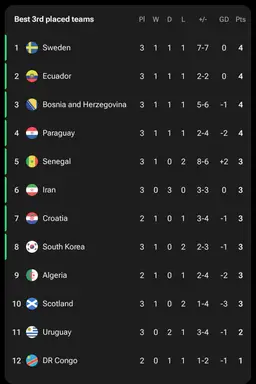
The dream is hanging by a thread, but for the Tartan Army, the calculators are officially out. Despite a crushing 3-0 defeat at the hands of Brazil that left manager Steve Clarke admitting, “I think we’re going home,” Scotland’s 2026 World Cup journey isn’t mathematically dead yet. With the tournament’s expanded format and a chaotic third-place table, Scotland has a path—albeit a narrow, treacherous one—to reach the knockout stages for the first time in their history.
The “Impossible” Odds
According to the data experts at Opta, Scotland currently sits with a staggering 0.07% chance of progression. Sitting 10th in the third-place standings—where only the top eight teams advance to the Round of 32—the Scots are in desperate need of a “perfect storm” of results across the final day of group stage action.
After a roller-coaster week where results involving South Korea, Ecuador, and Sweden pushed them to the brink, Friday night provided a flicker of hope. Spain’s victory over Uruguay kept the door slightly ajar, but Scotland’s fate is no longer in their own hands.
The “Six-Step” Path to Glory
To pull off what would arguably be the greatest escape in World Cup history, Scotland needs a precise sequence of events to unfold on Saturday. With a goal difference of -3, they aren’t just relying on wins and losses; they are relying on massive scoreline swings. Here is the gauntlet Scotland needs to survive:
- The Ghana Statement: In Group L, Croatia must be dismantled by Ghana, with a margin of victory of at least three goals.
- The Uzbekistan/DR Congo Stalemate: The Group K clash must end in a draw, or if Uzbekistan wins, it cannot be by more than three goals.
- The Group J Chaos: This is the most complex hurdle. Scotland requires Algeria to lose by two or more goals, OR Austria to suffer a defeat by at least four goals. (Note: If these two sides draw, the math becomes even more complicated as both would likely leapfrog the Scots).
A Manager at a Crossroads
Steve Clarke’s post-match comments after the Brazil defeat were marked by a rare candor that frustrated many within the Scottish support. Admitting that the team was “probably going home” before the group stages had even concluded drew sharp criticism from fans and pundits alike.
”The first thing we have to do is go away and compute that performance and why we lost the game in the manner we did,” Clarke reflected. “We can worry about the rest later.”
While the manager may have mentally checked out, the players and the fans are refusing to give up the ghost until the final whistle blows on the final group game. Whether Scotland is truly “going home” or about to make history remains to be seen, but Saturday promises to be a day of high-stakes tension, frantic score-checking, and the kind of “mathematical hope” that only a tournament as wild as the 2026 World Cup could produce.
Will it be a miracle in North America, or is the Tartan Army’s journey coming to an end? Keep your eyes on the scoreboards—because the impossible is officially on the menu.