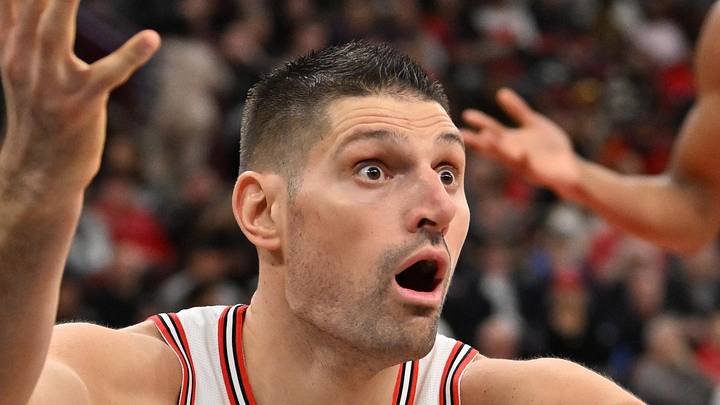
The Boston Celtics’ 2025–26 season ended in a collapse that will be analyzed for years to come. After securing the second seed and holding a dominant 3–1 series lead in the first round, the Celtics suffered a historic, franchise-defining meltdown against the Philadelphia 76ers. As the dust settles at the TD Garden, the front office is wasting no time identifying the casualties of that catastrophe—and Nikola Vucevic is at the top of the list.
An Audition Gone Wrong
When Brad Stevens acquired Vucevic at the trade deadline, the move was billed as a shrewd financial maneuver—a way to trim the cap while adding a seasoned, floor-spacing veteran to a title-contending roster. It was supposed to be a “plug-and-play” fit for Joe Mazzulla’s offense. Instead, it became a strategic liability.
A fractured finger derailed his momentum almost immediately, limiting him to just 16 regular-season appearances. But even when healthy, Vucevic looked like a square peg in a round hole. Averaging a meager 9.7 points and 6.6 rebounds in his limited regular-season time, the former All-Star never found the rhythm required to thrive in Boston’s high-octane system.
The Game 7 Disappearance
The true indictment of Vucevic’s tenure came when the stakes were at their absolute highest. With superstar Jayson Tatum ruled out for a win-or-go-home Game 7 against Philadelphia, the Celtics were desperate for scoring and veteran poise. Yet, when the game was on the line, Mazzulla—who had leaned on Vucevic throughout the series—effectively cut him from the rotation.
Vucevic finished his playoff run shooting a dismal 37.8% from the field and struggling to make a dent from beyond the arc. His defensive deficiencies, long considered an acceptable trade-off for his offensive versatility, became a glaring target. Joel Embiid and the 76ers systematically dismantled him, turning the veteran into a defensive liability that the Celtics simply could not afford to keep on the floor.
A Necessary Breakup
According to NBA insider Marc Stein, it is now a “certainty” that Vucevic will switch teams this summer. For the Celtics, this isn’t a loss; it’s a necessary correction. With limited financial flexibility and the looming shadow of the luxury tax, Boston cannot afford to pay for veteran production that doesn’t materialize when the postseason lights are brightest.
Brad Stevens has already pivoted to the offseason, with the front office prioritizing an upgrade at the center position. Neemias Queta and Luka Garza are serviceable, but they cannot carry the load for an 82-game campaign, and the team’s current defensive deficiencies at the five-spot are a major concern.
For Vucevic, the audition in Boston is over. He will head to the open market, likely drawing interest from teams looking for mid-level spacing and veteran depth. For the Celtics, the focus is clear: put the 2026 collapse in the rearview mirror, find a legitimate defensive anchor, and rebuild the frontcourt for a championship-caliber run in 2027. The Vucevic era in Boston lasted only a few months, but it served as a brutal reminder of the thin line between a “shrewd move” and a missed opportunity.