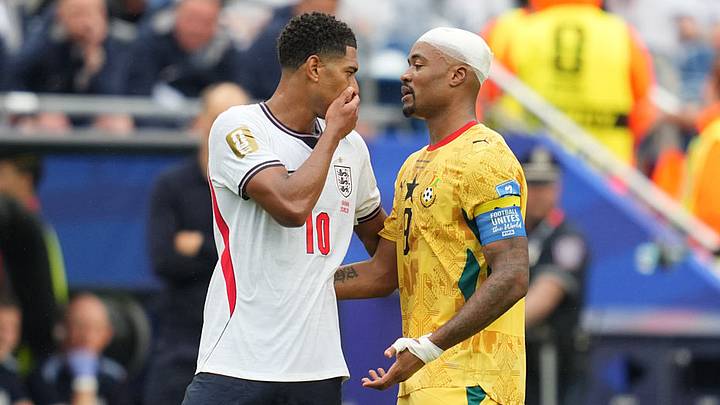
The 2026 World Cup has introduced a controversial new layer to officiating that has left fans, players, and pundits in a state of constant confusion: the “Prestianni Rule.” After England’s Jude Bellingham was seen covering his mouth during a conversation with Ghana’s Jordan Ayew—avoiding the same fate that saw Paraguay’s Miguel Almirón sent off just days earlier—the debate has exploded. Is the rule a stroke of genius for player respect, or a subjective nightmare?
Here is exactly why Bellingham stayed on the pitch, why others are getting sent off, and what this “secret” rule really means for the remainder of the tournament.
The Distinction: Friendly Chat vs. Confrontational Clash
The core of the frustration stems from a misunderstanding of FIFA’s intent. Following a heated incident where Paraguay’s Miguel Almirón covered his mouth while confronting Türkiye’s Mert Müldür, the referee had no choice but to issue a straight red card. To the untrained eye, it looked like a harsh punishment for a simple gesture.
However, FIFA’s Head of Referees, Pierluigi Collina, had previously laid out the ground rules: “If the conversation is a friendly conversation, they can continue to do it without any problem. When the conversation is confrontational, covering the mouth means that you are doing something very wrong.”
In Bellingham’s case, while he was involved in a tense match against Ghana, his specific interaction with Jordan Ayew was deemed non-hostile. It was a chat between professionals, not a confrontation. Referee Hector Said Martinez Sorto correctly identified that the context didn’t cross the threshold into “confrontational,” allowing the England star to avoid an automatic suspension.
Where the ‘Prestianni Rule’ Actually Comes From
The rule isn’t just about policing gestures; it’s a direct response to a dark moment in football history. The mandate was born following an incident involving Benfica winger Gianluca Prestianni, who was accused of hurling discriminatory slurs at Real Madrid’s Vinícius Jr. while covering his mouth.
Prestianni’s attempt to claim he used a different, albeit still offensive, slur did not save him from a massive UEFA-backed ban. The incident forced FIFA to take a stand. As FIFA President Gianni Infantino put it: “If you have nothing to hide, you don’t cover your mouth when you speak to somebody. The rules have been made very clear to everyone.”
The High Stakes of a “Silent” Offense
The “Prestianni Rule” is effectively designed to eliminate discriminatory language from the game by removing the “cover” players use to hide their words. FIFA’s logic is simple: if you are covering your mouth in a confrontational moment, you are inviting suspicion. If that suspicion is validated by the officials as discriminatory or abusive, the sanction is the most severe in the game—an automatic red card and a mandatory suspension.
The Verdict
For England fans, it is a sigh of relief. Jude Bellingham will be available for the Three Lions’ crucial group stage finale against Panama at MetLife Stadium. For the rest of the tournament, however, the message from FIFA is clear: the era of covering one’s mouth during heated exchanges is over.
As we head deeper into the World Cup, expect referees to be even more vigilant. Every hand over a mouth during a dispute is now a high-stakes gamble. The players know the rule, the cameras are watching, and one bad-faith gesture is now all it takes to end a player’s tournament dreams in an instant.